Nuts are a common fastener used in conjunction with bolts to connect or secure structural components. However, in the presence of vibration, shock, temperature changes or dynamic load environment, ordinary nuts because only rely on thread friction and clamping force, long-term use may gradually loosen, or even fall off.
In order to solve this problem, the “lock nut” – also known as “self-locking nut / anti-loosening nut / anti-vibration nut” – has emerged. Lock nuts provide a higher degree of resistance to loosening than ordinary nuts, maintaining a strong, reliable connection even under conditions of severe vibration, shock, or temperature/pressure fluctuations.
In short, a lock nut is a threaded fastener specifically designed to prevent the automatic loosening of a nut.
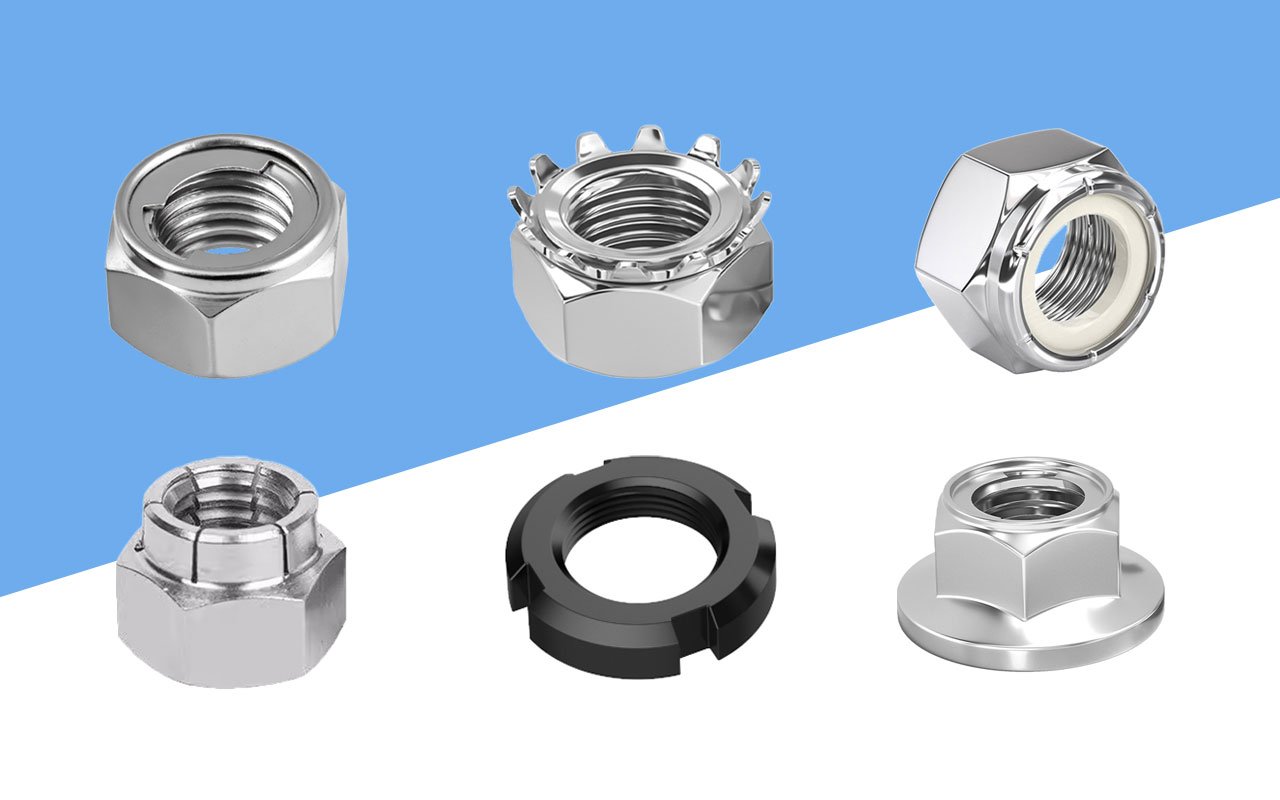
What Types of Locknuts Are Available?
Nylon Insert Lock Nuts
All-Metal Hex Lock Nuts
Flange Lock Nuts
K-Lock Nuts
Slotted Self-Locking Nuts
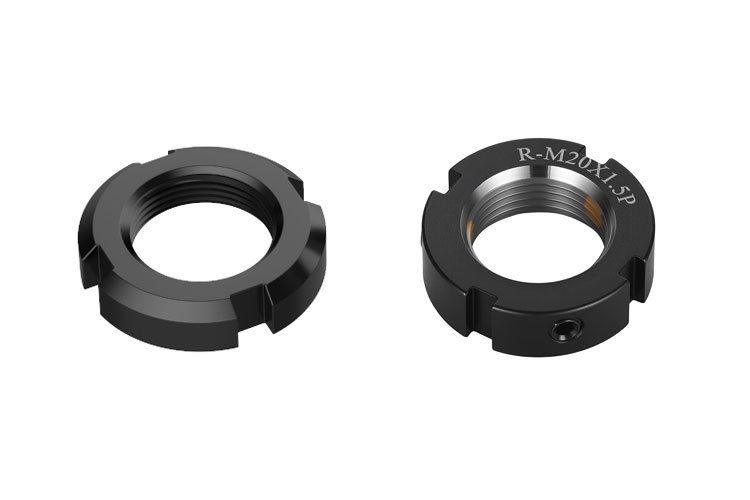
Bearing Lock Nuts
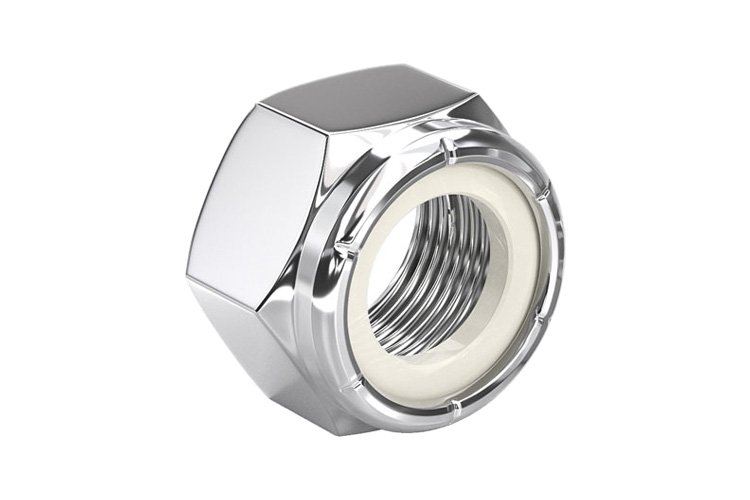
Nylon Insert Lock Nuts
A nylon lock nut has a nylon ring embedded at the top inside a regular hexagonal nut. During tightening, the nylon ring is compressed by the bolt threads, forming a screw that firmly engages the nut with the bolt. The elastic force of the nylon also generates frictional resistance, thus preventing loosening.
Note: Non-metallic insert lock nuts are not suitable for high-temperature conditions; the applicable temperature range is -50℃ to 100℃. They are not suitable for use in environments with inorganic acids or strong alkalis. If the nylon ring is found to rotate during assembly, the nut must be replaced. If reused, it should not be installed more than 20 times.
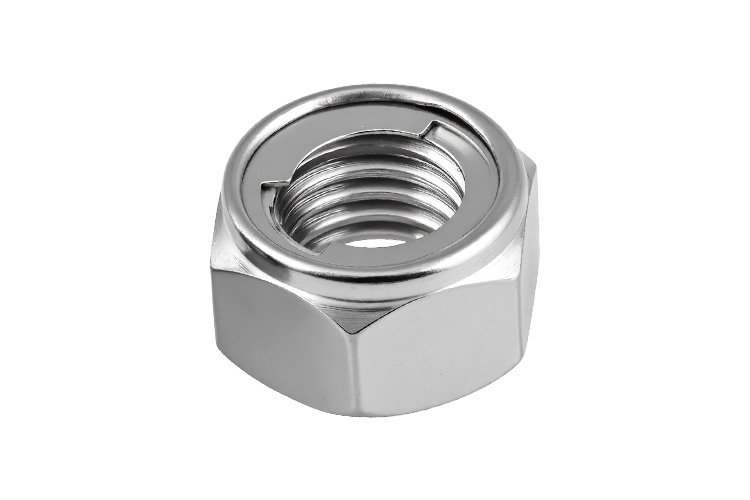
All-Metal Hex Lock Nuts
All-Metal Hex Lock Nuts, or Distorted-Thread Locknuts, enhance locking effectiveness by deforming the internal parts of the thread or nut (e.g., eccentricity, flattening, twisting, protrusion, slightly smaller inner diameter, etc.) to create continuous “preload” friction or mechanical interference when mated with a bolt. Because it is an all-metal structure, it can remain stable even under high temperature and high load.
Commonly used metal lock nuts include hexagonal nuts, hexagonal flange nuts, and dodecagonal flange nuts.
Metal lock nuts offer high reliability in preventing loosening under vibration conditions; lock nuts made of different metals can be used in various temperature environments.
However, due to the inherent deformation resistance of metal materials, the deformation of all-metal nuts is difficult to control. This can lead to significant variations in the anti-loosening torque, making them prone to seizing during assembly.
Furthermore, after assembly, friction can easily damage the plating on the thread surface of these lock nuts, affecting their corrosion resistance.
Note: When assembling all-metal lock nuts, the speed of the assembly tool should not be too high; if the lock nut is galvanized, Dacromet coated, or otherwise surface-treated, lubrication should be applied before use; metal lock nuts can be reused, but repeated installation should not exceed 5 times.
Flange Lock Nuts
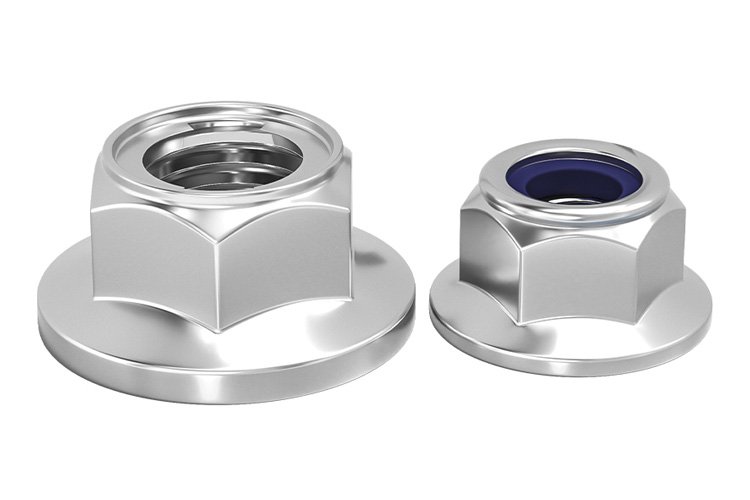
These nuts have a flange face at the bottom, which typically has a serrated or corrugated structure. When tightened, the serrations engage the contact surface, using friction and the resistance of the contact surface to prevent the nut from loosening. Flange lock nuts can also be combined with nylon rings or metal locking plates.
K-Lock / Keps nut
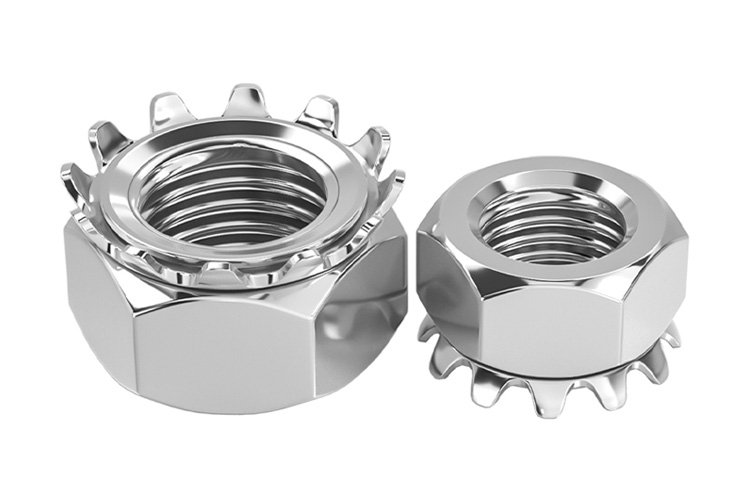
A K-Lock or Keps nut is a hexagonal nut with a serrated washer at the bottom. When tightened, the serrated edge of the washer bites into the metal/material of the contact surface, thereby enhancing the anti-loosening effect through friction and clamping force.
Slotted Self-Locking Nuts
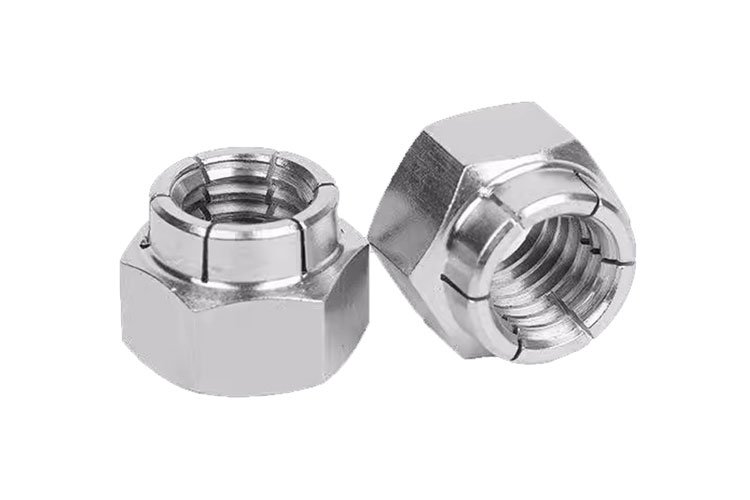
Slotted self-locking nut in the process of use, when the bolt is screwed into the nut, it will automatically hold up the end of the nut, under the action of the nut contraction and deformation force, so that the threads closely fit and produce friction resistance, in order to achieve the purpose of anti-loosening.
Features: Slotted self-locking nuts have a stable torque, good anti-loosening effect and can be reused; by changing the material of the nut, it can be applied to different working conditions at different temperatures.
Note: Slotted self-locking nuts in use, be careful to observe the contraction of no transverse cracks occur; in repeated use, you need to pay attention to the contraction of the end of the nut is not enough to have the elasticity of the contraction part.
Bearing Locknuts
Used for bearings, rotating shafts, and other areas where directional locking is required. Positive locking is often achieved by means of a structural design + locking washers / locking pins / slotted fit pins.
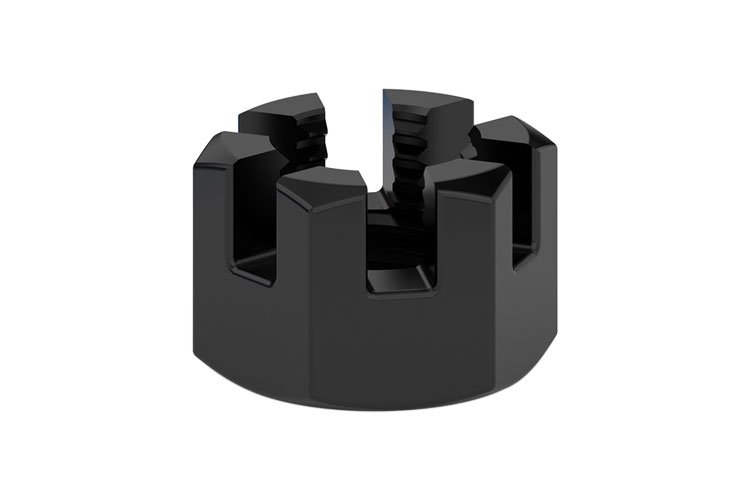
Hexagon Slotted Lock Nuts
Slotted nuts are used with cotter pins, but they do not prevent loosening. Slotted nuts are simpler to assemble, but less efficient and can be reused. When using them, pay attention to the selection of cotter pins to meet the design requirements.
International Standards for Locknuts
| Hexagonal Nylon Lock Nuts | Metal Lock Nuts | Flange Lock Nuts | Locknuts for Bearings |
| Thick nylon locknut: DIN 982. Hexagonal locknut: DIN985, ISO7040. Hexagonal nylon thin locknut: ISO10511. | Metal hexagon locknuts: DIN 980M. Face oval hexagon locknuts: DIN 980V. | Serrated hexagon flange nuts: DIN 6923, ISO 4161 and JISB 1190 Flange nuts with nylon ring at the top: DIN 6926. Flange lock nuts with inserts at the top: GB 6187.4. Standard for fastening nuts: DIN 7967. | Circular groove bearing locknuts: DIN 70852, DIN 981 and DIN 546. Standards for hexagonal shaft locknuts (also known as hexagonal groove locknuts): DIN 935, GB 6178, GB 6181. |
Lock Nut Specifications
Metric locknuts: M6 to M50.
Inch Locknuts: UNC — 0.0730“ to 0.2160”, values range from 1-64UNC to 12-24; UNF — 0.0600“ to 0.2160”, 0-80UNF to 12-28UNF. 28 UNF.
Material of Locknuts
- Stainless steel: 304, 316; attractive appearance and rust resistant.
- Carbon steel: high strength; need to be galvanized or hot-dipped galvanized, Dacromet, etc. to prevent corrosion or rust.
- Aluminum alloy: 6061; anodized.
- Special environment: brass, titanium alloy, high temperature alloy.
How to Install the Lock Nut?
- Select a locknut that matches the bolt or threaded rod
- Keep the threads clean
- Use with the corresponding locking structure (e.g., lockwashers, stop tabs, etc.)
- Use a wrench or torque wrench to achieve the specified torque to prevent over- or under-torquing.
Uses of Locknuts
- Automobile
Chassis, engine, body, braking system.
- Mechanical equipment
Excavators, loaders, cranes, pavers, tower cranes; Heavy loads, impacts, muddy environments and frequent maneuvers make it imperative for construction machinery to use strong vibration-resistant locknuts.
- Construction
Steel beam and column nodes, bridge connection bolt systems, solar racks, wind turbine tower structures
- Electrical Appliances
Motor end caps, electronic control boxes, internal structural supports for home appliances, light mechanical equipment.
LOCKING NUT VS. REGULAR NUT
Regular nuts rely solely on thread friction and preload to maintain the connection. They are prone to loosening under vibration, impact, temperature changes, and dynamic loads.
Locking nuts provide “pre-resistance/mechanical locking/friction enhancement” through additional mechanical structures (nylon rings, metal deformation, flange serrations, locking plates/washers/locking pins, etc.), ensuring a stable connection even under harsh conditions.
For structural connections requiring high reliability, safety, and low long-term maintenance, locknuts significantly improve safety and durability.
Commonly used locknuts are introduced here, about fasteners to prevent loosening, do you have any other methods?