Machine screws are a common type of fastener that is usually used to securely join two or more parts together and are widely used in the assembly of mechanical and electronic equipment. This article provides you with a detailed introduction to the types of machine screws, their characteristics and their important role in various types of fasteners, and offers readers a practical guide to selecting and using machine screws.
What Is a Machine Screw?
Machine screws consist of a head, a screw, and are a type of screw specialized for mechanical assembly. They are usually made of stainless steel or alloy materials, with precision thread design, usually with nuts, washers or screwed directly into the threaded holes used. The main function of machine screws is to tightly fix two or more parts together, suitable for achieving precise fastening effects in a variety of equipment.
The American Society of Mechanical Engineers (ASME) defines machine screws as not exceeding 0.75 inches in diameter. They can be less than 0.75 inches in diameter, but not larger. As a result, machine screws are typically smaller than most other types of screws.
According to the different head shapes, thread types and materials, machine screws can be divided into a variety of types, such as flat head screws, round head screws, cross recessed countersunk head screws, cross recessed pan head and hexagon socket cylindrical head screws. Machine screws and wood screws, self-tapping screws, etc. are the most common and most widely used types of screws. Machine screw thread can be divided into coarse thread and fine thread. Coarse threads are more common for general use, while fine threads are used for occasions that require precision fixing.
The Role of Machine Screws
The role of mechanical screws is to realize the connection of parts and accurate positioning so that scattered parts into a solid whole, first of all, the fastening connection, through the screw and threaded holes in the joint, the scattered parts are fixed into a whole, such as the assembly of automotive parts. Next is the precise positioning, in the precision equipment, mechanical screw threads can be fixed parts, limit the displacement of parts and shaking, to ensure the precision of equipment operation.
Advantages
- Strong stability, small fit gap between threads, not easy to loosen after tightening the connection, and still maintain good stability under the influence of external forces.
- High versatility, in accordance with national and international standards of production, different brands of screws can be replaced with each other, reducing the production and maintenance costs.
- Wide range of adaptability, by adjusting the material, specifications and head, it can meet different assembly requirements from precision equipment to heavy machinery.
- Convenient installation and disassembly, installation and disassembly only need to use conventional tools, do not need special equipment, improve the assembly efficiency.
- Reusable, compared with self-tapping screws, machine screws can be used many times without damaging the threaded holes, suitable for occasions requiring frequent disassembly.
Material of Machine Screws
The material of the machine screw will determine the strength, corrosion resistance and applicable environment of the product, generally carbon steel, alloy steel, stainless steel, copper, aluminum alloy, titanium alloy and etc.
Carbon steel is one of the most common materials used for machine screws, consisting mainly of iron and carbon. It is economical and moderately hard. The strength is generally available in grades 8.8, 10.9, and 12.9, and is used in applications where hardness is required.
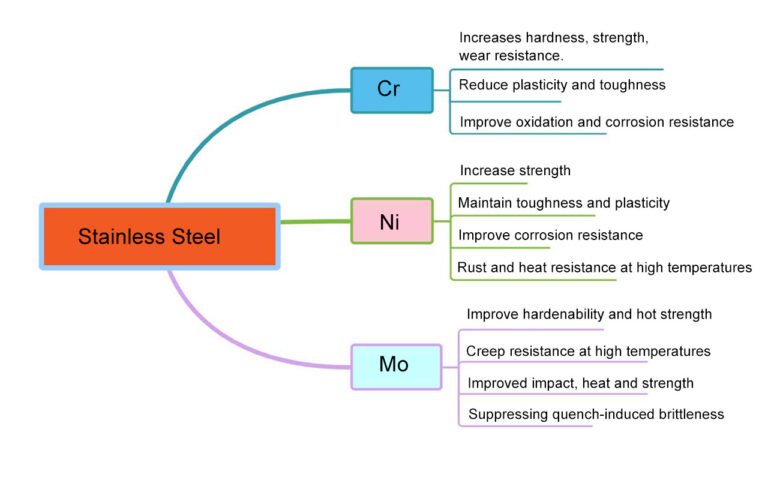
Stainless steel is a popular material used in the manufacture of machine screws. It is strong and durable and offers a high level of protection against rust and corrosion. It is suitable for use in humid, acidic and alkaline environments. Common types are A2 (304) and A4 (316). 316 stainless steel is more resistant to corrosion and is mostly used in medical, marine, and chemical equipment.
Copper has good electrical and thermal conductivity, not easy to rust, widely used in electrical equipment and bathroom fittings.
Aluminum is another common material used in the manufacture of machine screws. With its light weight, high strength and corrosion resistance, it is used in aerospace and automotive manufacturing. However, aluminum machine screws are not as hard and strong as stainless steel, so they are often used in applications that require weight reduction rather than high strength.
Surface Treatment
- Zinc plating (for mild corrosion protection in general environments, optimal cost).
- Nickel plating (nickel-plated screws appear silver-white look more beautiful, but also has good corrosion resistance and conductivity).
- Black and blue (the screw surface oxidation to form a black or blue-black oxide film, this oxide film has corrosion resistance and lubricity, can reduce wear).
- Teflon (for industrial chemical resistance and low friction).
- Dacromet treatment (preferred for long-lasting anti-corrosion in harsh industrial environments).
How to Choose a Finish?
- Outdoor industrial infrastructure (wind power, power transmission): Zinc plating (cost-effective corrosion protection)
- Indoor light-duty industrial equipment (machine tools, distribution cabinets): Zinc plating / black oxide (cost control)
- Chemical / food industry (corrosion resistance / low friction): PTFE (Teflon) coating
- Marine / heavy-duty harsh environments (salt spray / high temperature resistance): Dacromet coating
- Precision / conductive applications (electronics, medical): Nickel plating
Types of Mechanical Screws
Depending on the type of grooves in the head and the top, there are various types to suit different assembly scenarios.
- By head type: cylindrical head, countersunk head, flat head, spherical cylindrical head, pan head, countersunk head, hex head.
- By slot type: slotted, cross-slotted, hex socket, cross-recessed, cross-slotted, hex star/torx.
The diverse types of machine screws reflect their high compatibility in industrial and everyday applications, while also demonstrating the product’s high level of refinement.
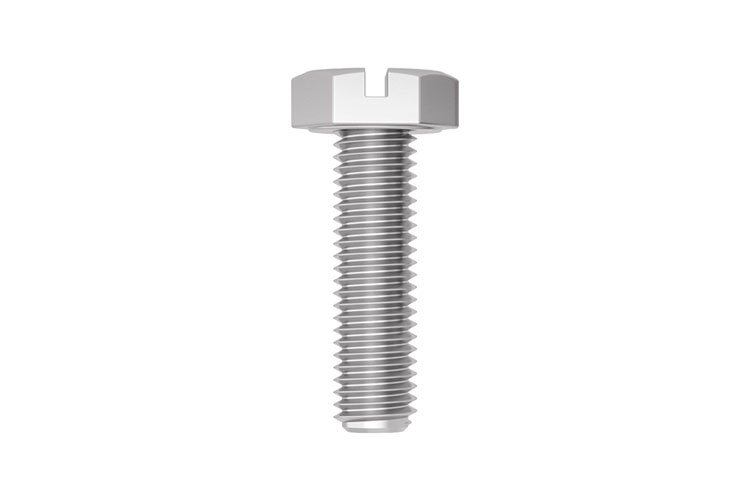
Hex Head Slotted Machine Screw
The head is hexagonal in shape with a single slot for assembly environments that require high tightening torque and generous space.
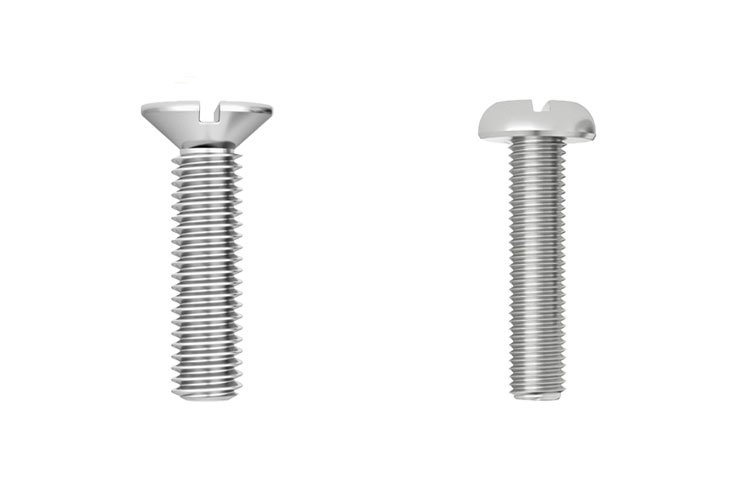
Slotted Machine Screw
It is mostly used for the connection of smaller parts. It has pan head screws, cylindrical head screws, semi-countersunk head screws and countersunk head screws. Pan head screws and cylindrical head screws of high strength, used in ordinary parts connection; semi-countersunk head screws head is curved, after installation, it is slightly exposed at the top, and beautiful and smooth, generally used in instruments or precision machinery; countersunk head screws are used for places that do not allow the head to be exposed.
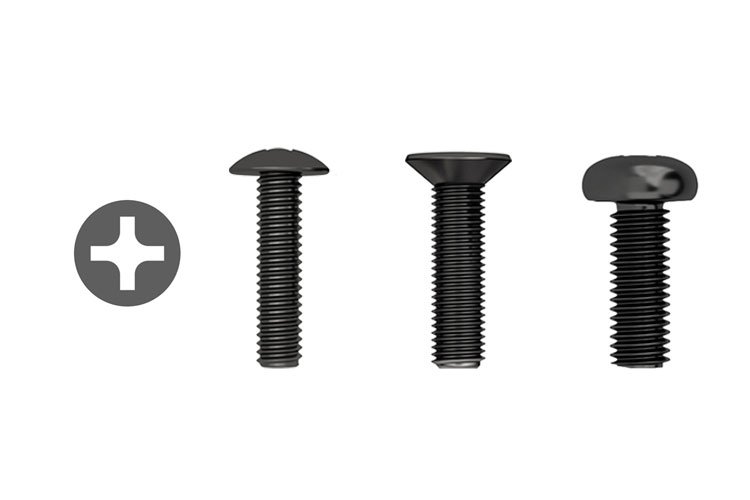
Cross Recessed Machine Screw
It is similar to the use of slotted common screws, can be replaced with each other, but the slotted cross slot common screws have higher strength and more beautiful appearance. The use of matching cross-shaped screws must be used for loading and unloading.
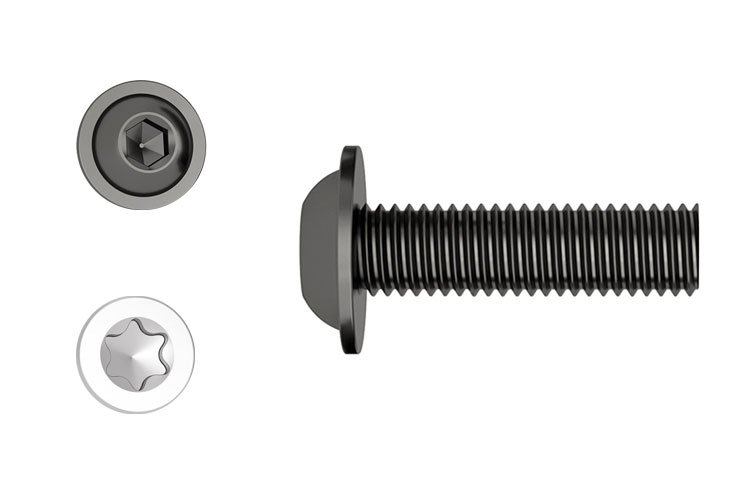
Hex Socket Screws and Torx Screws
The heads of these screws can be countersunk into components, allowing for the application of higher torque and achieving greater connection strength, making them suitable replacements for hex bolts. They are commonly used in connections where compact structure and a smooth appearance are required.
How to Choose the Right Machine Screw?
There are several factors to consider when choosing machine screws:
- Materials
Select materials according to the environment and application. In corrosive environments, such as marine or chemical plants, it is more appropriate to choose corrosion-resistant stainless steel or aluminum alloy machine screws; while in dry, non-corrosive environments, carbon steel screws are more cost-effective.
- Performance Grade
According to the load-bearing capacity of the screws, choose the appropriate performance level. Ordinary grade 4.6 screws have a load capacity of 3270 N, grade 8.8 is 8240 N, and grade 10.9 is 11800 N. For connections with high strength requirements, such as key components of machinery and equipment, high carbon steel or alloy steel machine screws are ideal; while in occasions where the strength requirements are not as high, but where lighter materials are needed, such as aerospace components, aluminum alloy screws are more suitable.
- Head Type
Select different head shapes such as flat, round, or hex socket based on your requirements.
- Electrical Performance
In electrical equipment, the choice of good electrical conductivity of brass or nickel-plated steel machine screws can ensure good electrical conductivity and contact stability.
- Size
Select the appropriate size based on the thickness of the connector and the diameter of the threaded hole to ensure the screw fits securely.
Uses
Machine screws are usually superior to other larger screws. They offer a wider range of applications due to their small size. Machine screws can be used to attach countless types of products, objects and surfaces.
Mechanical Equipment: Used for fixing parts and components of equipment, such as motors, gears and transmissions.
Electronic Products: Used to fix circuit boards, housings and other components.
Construction: Commonly used in the installation of metal structures, doors and windows.
Automotive: High-strength anti-loosening screws for connecting engine, body, and other components.
Aerospace: Lightweight and durable titanium screws
Medical Devices: Stainless steel and titanium screws for diagnostic and testing equipment.
Summary
Mechanical screws as fasteners in the most basic existence, its use really let us not ignore, selection, installation, maintenance are affecting the smooth use of equipment, long-term use of factors. From the choice of material to the surface treatment of each link should be done to achieve precision control, in the actual application of a mechanical screw is not the best one, only the most suitable mechanical screws. According to the environment, the force situation, the choice of mechanical screws, in order to play its maximum use. So, which type of machine screw will you choose for your project?
Machine Screws: FAQ
Q1: How can I prevent machine screws from loosening?
You can use a lockwasher, apply thread adhesive, or use a double nut locking method.
Q2: Difference between machine screws and self-tapping screws
Visually, machine screws feature a uniform diameter throughout their length, while self-tapping screws have a pointed tip at the end. Machine screws have a flat head with a thread angle of 60° both before and after the thread, and their specifications are marked as M. Self-tapping screws have wider threads with an angle generally less than 60°, and their specifications are marked as ST.
Beyond their visual and assembly differences, machine screws and self-tapping screws serve distinct applications. Machine screws are more commonly used within machinery, equipment, or hard materials—such as in mechanical manufacturing, automotive production, furniture fabrication and assembly, and steel structures in construction. Self-tapping screws, conversely, are primarily employed in non-metallic or softer metallic materials like wood, steel plates, and aluminum.
Q3: What is the difference between a bolt and a screw?
Bolts are widely used in machinery manufacturing for detachable connections, generally used in conjunction with nuts (usually plus a washer or two washers). Screws are usually used alone (sometimes with a washer), generally for fastening or fixing needs to be screwed into the internal threads of the body.
Global Supplier of Mechanical Screws
BD Fastener offers both metric and inch machine screws, including a selection of machine screws in different standards, sizes, materials and finishes. If you are looking for machine screws, contact BD Fastener online to help you.