In many mechanical systems, bolts and nuts may loosen their threaded connections due to shock, temperature, or vibration and fail to maintain preload over time. Lock washers are important fasteners designed to solve this problem.
In this article, we will provide you with step-by-step answers from the definition of lock washers, materials, working principle, types, and usage.

What Is a Lock Washer?
Lock washers are fasteners used in conjunction with bolts and nuts. It has a toothed structure or elastic deformation capability. The lock washer spreads the load and locks the bolt in place.
Locking washers are used to prevent threaded connections from loosening under vibration or dynamic loads, providing additional friction or elastic preload to improve the long-term stability and safety of the connection.
Why Do Bolt Connections Loosen?
1. Vibration and Alternating Loads
In a vibrating environment, threaded connections experience slight relative slippage, causing the preload to gradually decrease.
2. Thermal Expansion and Contraction
Temperature changes cause materials to expand or contract, disrupting the original clamping force balance.
3. Embedding
Microscopic unevenness of the contact surface is flattened after the initial stress, resulting in a reduction in preload.
4. Changes in the coefficient of friction
Lubrication, coatings or corrosion can change the friction conditions and affect the locking effect.
Materials for Lock Washers
- Carbon Steel
Economical and strong, corrosion resistance can be enhanced by surface treatment.
- Stainless Steel
Aesthetically, corrosion resistant.
- Alloy Steel
Carbon steel with chromium, molybdenum and nickel to enhance strength and wear resistance.
- Aluminum
Lightweight and corrosion resistant.
- Brass
Corrosion resistance, good electrical conductivity.
- Silicon Bronze
Durable, fatigue resistant.
- Nylon
Insulating, chemical resistant.
How Lock Washers Work
- Elastic preload
Split spring washers and saddle washers elastically deform during tightening, continuously exerting reverse pressure on the threaded connection.
- Mechanical Clamping
External and internal tooth lock washers embed into the surfaces of the connected components, forming a physical lock.
- Friction Locking
Wedge lock washers reduce the likelihood of rotation of a nut or screw by increasing the coefficient of friction of the contact surfaces. When the bolt and nut are tightened, the wedge-shaped teeth on the internal contact surfaces of the two washers are tightened together to achieve a locking effect.
Types of Lock Washers
External tooth lock washers
The washer has serrated outer edges that engage with the contact surface during tightening, creating a mechanical lock. Suitable for large-diameter fasteners.

Standard:DIN6797A, DIN6798A
Size:metric M2 and M30 1 in~9/16 in, #4~#12.
Internal tooth locking washers
The inner edge of the washer has a toothed profile, suitable for screws and bolts.
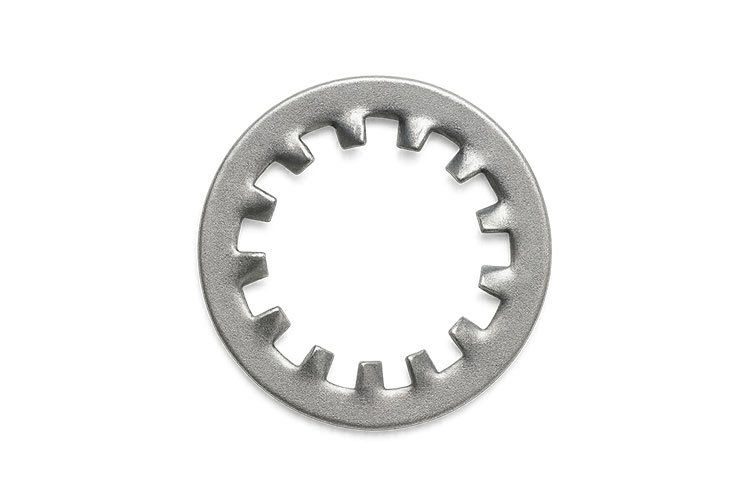
Standard:DIN6797J, DIN6798J
Split washers
Split washers, also known as spring split washers, open ring structure, with axial elasticity, low cost, widely used, in high vibration conditions with limited ability to prevent loosening.

Standard:DIN127, DIN127B, DIN7980. JIS B1251, GB/T 93
Size:M2~M56, # 2~# 12, 1 in~9/16 in
Saddle washers
Saddle washers have a wavy structure in the axial direction and belong to a kind of elastic washers, providing spring pressure when compressed.

Standard:DIN128B, DIN137B, JB7590.
Uses:Light load, vibration damping.
Wedge-Lock Washers
Wedge-lock washers, also known as double-layer self-locking washers, are used in pairs and in opposite directions. The locking force is generated by tension rather than friction, and becomes tighter under vibration conditions.

Standard:DIN25201 Wedge-Lock Washers.
Size:M6~M36# 5~#10, 1 in~5/8 in.
Disc washers
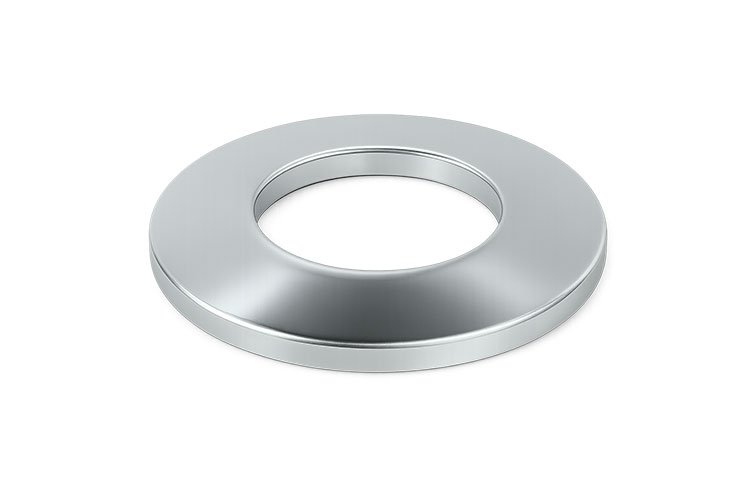
Tapered or disk-shaped, with high load-bearing capacity and adjustable elasticity.
Lock Washers VS Regular Washers
| Comparison Items | Lock Washers | Plain Washers |
| Loose or not | Yes | No |
| Structural features | Spring / Teeth / Conical | Flatness |
| Application environment | Vibration, Impact | Static load |
| Costs | High | Low |
Can Lock Washers Be Reused?
Most lock washers are not recommended for reuse. Because of the plastic deformation that often occurs after disassembly, their elastic preload is significantly reduced, and their anti-loosening performance is uncontrollable and a safety risk.
How to Install Lock Washers
- Ensure that the bolt/nut/lock washer/connecting surface is clean and free of oil.
- Place the locking washer flat on the contact surface
- Tighten the nut or bolt to the recommended torque value
- Perform a secondary torque check if necessary
How to Remove Lockwashers
- Slowly reverse the rotation of the nut or bolt using a wrench or socket of the appropriate size.
- Prevent sudden unloading to avoid ejection of the washer.
- After removing the nut, check that the washer is not embedded in the surface of the connected part.
How to Choose a Lockwasher?
| Type | Vibration Resistance | Reusable | Common Materials |
|---|---|---|---|
| Spring washers (split washers) | Low | / | Carbon Steel, Stainless Steel |
| External Toothed Lock Washers | Medium | / | Carbon Steel, Stainless Steel |
| Internal Toothed Lock Washers | Medium | / | Stainless Steel |
| Saddle Washers | Low | Limited | Stainless Steel |
| Serrated Washers | Medium | / | Carbon Steel |
| Wedge Lockwashers (Double Stack) | Excellent | ✔ | Carbon Steel, Stainless Steel |
| Spherical Lockwashers | Medium | ✔ | Alloy Steel |
| Square Lock Washers | Low | ✔ | Carbon Steel |
| Nylon Lock Washers | Medium | / | Metal + Nylon |
Note: If you’re not sure how to make a selection, contact our team online.
Uses of Lock Washers
- Automotive & Commercial Vehicles
Engines, suspension systems, brake components.
- Machinery Manufacturing
Gearboxes, pumps and valves, automation equipment.
- Electrical and Electronics
Grounding connections, control cabinets, power distribution systems.
- Railroad, Ship, Wind Power
High-vibration, high-security connections.
Customize Your Lockwashers
Tailored Materials, Dimensions, and Performance
Locking Washer FAQs
Q1:Do lock washers always prevent loosening?
Lock washers can only reduce the risk of loosening, not absolute anti-loosening, should be used with the correct torque, reasonable structure.
Q2:Can lock washers replace lock nuts?
No, they cannot be used in place of locknuts, but can be used in combination.
Q3:What are the common causes of lock washer failure?
- Repeated use
- Insufficient or excessive torque
- Surface too smooth
- Mismatch between material and operating conditions