What Is a Washer?
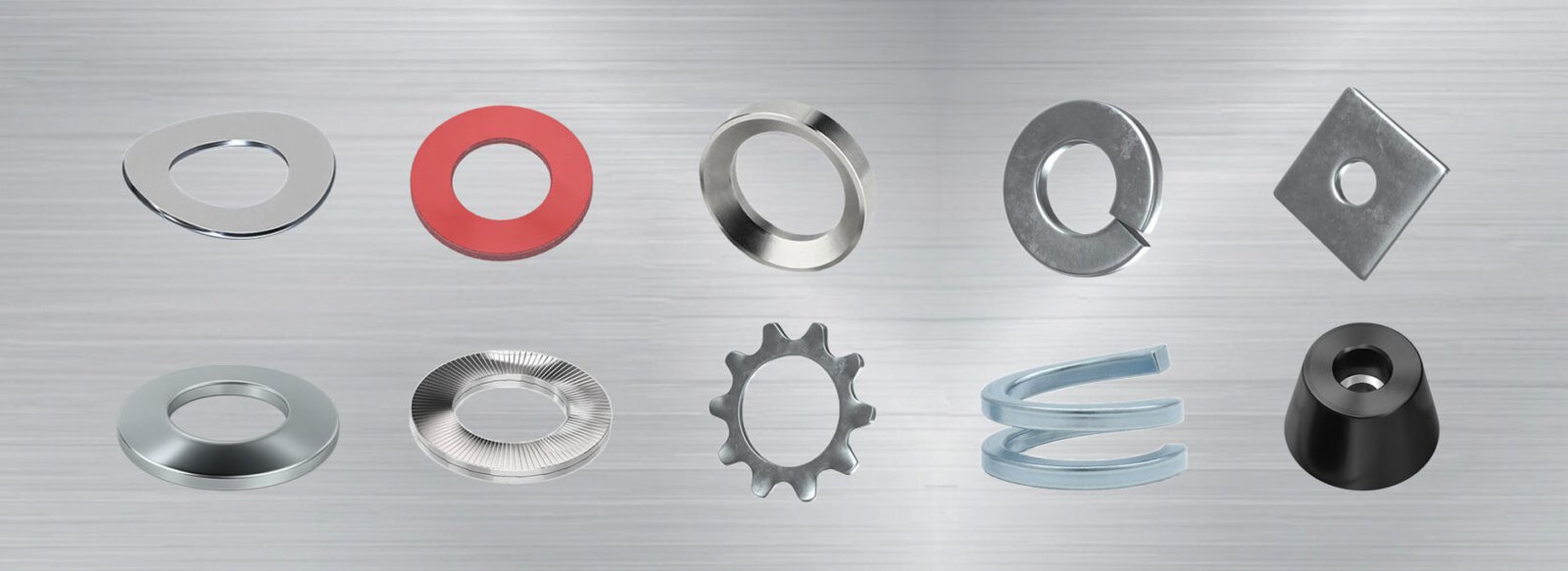
Washers are fasteners used between the bearing surface of bolts, screws, or nuts and the connected parts. They serve to protect the surface of the connected parts, prevent the fastener from loosening, and have other special purposes. Based on their specific functions, washers can be divided into flat washers, spring washers, anti-loosening washers, and special-purpose washers such as sealing washers.
Flat Washers
Flat washers are what we commonly call ordinary washers. They are the most commonly used type of washers and are used in most bolt or screw connections. Flat washers can improve the stress condition of the connected parts and protect the surface condition of the connected parts. In other words, they increase the contact area, reduce friction and pressure, and thus protect screws and nuts.


Flat washers are mostly round, but other shapes such as square washers are also available depending on assembly requirements. Specific types include flat washers (Class C), large washers (Classes A and C), extra-large washers (Class C), small washers (Class A), flat washers (Class A), flat washers with chamfered edges (Class A), and square washers, etc.
Spring Washers
After the connecting parts are tightened, the spring washer will increase the axial tension between the connecting parts by its own reaction force, thereby increasing the friction and preventing loosening.
Spring washers are widely used in both load-bearing and non-load-bearing mechanical structures. Due to their low cost and ease of installation, they are particularly suitable for applications requiring frequent disassembly and reassembly.

Saddle Spring Washer

Belleville Spring Washer
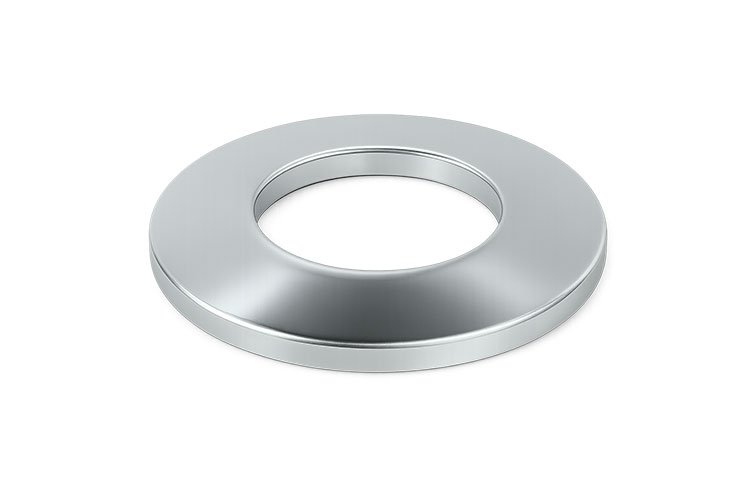
Conical Disc Spring Washer
Common types of spring washers include standard spring washers, light-duty spring washers, heavy-duty spring washers, wave spring washers, tapered elastic washers, and saddle-shaped spring washers.
Anti-Loosening Washers
Anti-loosening washers are washers that lock the connection between parts. They include locking washers that prevent loosening through mechanical fixing, and locking washers that achieve locking by increasing friction. The spring washers mentioned above can also be considered a type of anti-loosening washer.
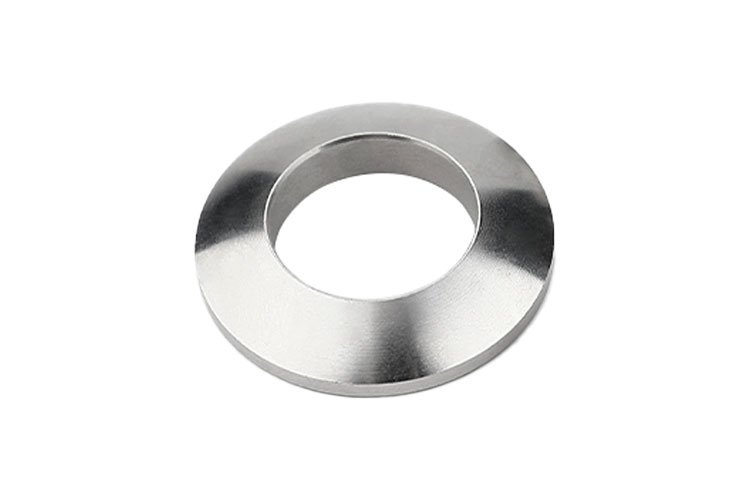
Spherical Spring Washer
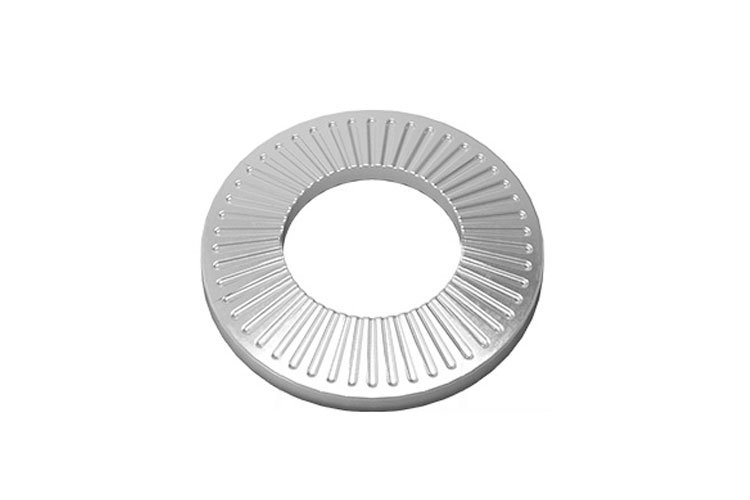
Knurled Disc Spring Washers
Thrust Washers
Thrust washers include single-eared thrust washers, double-eared thrust washers, internal tongue thrust washers, and external tongue thrust washers. Their function is to prevent relative movement between the thread and the connected parts, or between the threaded connection pairs, thereby preventing the threaded connection from loosening.
Locking Washers
Locking washers include SK toothed self-locking washers, double-sided locking washers, internal tooth locking washers, internal serrated locking washers, external tooth locking washers, and external serrated locking washers, etc. They primarily achieve locking by increasing friction.

External Tooth Lock Washer
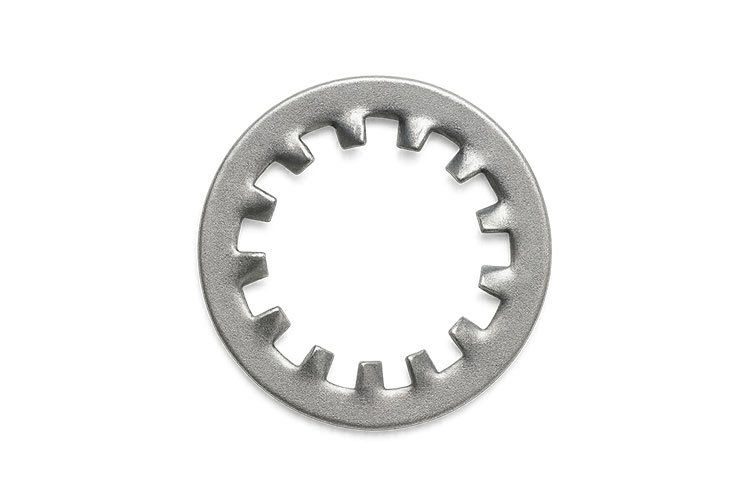
Internal Toolth Lock Washer

Serrated Lock Washer
Internal/external tooth locking washers prevent threaded connections from loosening by the meshing force between the tooth tips and the surface of the connected parts, along with a relatively small amount of elasticity.
Special Purpose Washers
Special purpose washers are those with additional functions, such as sealing washers, spherical washers, and beveled square washers.
Sealing washers prevent leaks and are commonly used in fluid-contaminated environments, such as between pipes or between components of machinery. Many non-metallic washers are sealing washers, including aluminum and copper ones.
Spherical washers can automatically adjust their position to distribute force evenly and increase friction, thus playing a certain role in preventing loosening. Spherical washers are usually used in sets.
Beveled square washers ensure the nut’s bearing surface is perpendicular to the threaded rod, preventing bending stress on the rod during tightening. They are commonly used on the beveled surfaces of channel steel or I-beams.
What Types of Metal Washers Are There?
The most representative grades of the 300 stainless steel series are 304, 304L, 316, and 316L stainless steel, which have good corrosion and rust resistance.

Stainless Steel Flat Washer

Red Steel Paper Insulated Flat Washer
304 stainless steel
304 stainless steel is designated as 06Cr18Ni10 in GB standards, also known as 18/8 stainless steel. This refers to its content of 18%–20% chromium (Cr) and 8%–10% nickel (Ni). It is prone to stress corrosion and intergranular corrosion within a temperature range of -196℃ to 538℃. The suitable operating temperature for 304 stainless steel washers should not exceed 760℃.
304L stainless steel
304L stainless steel, the “L” indicates that it has undergone decarburization treatment, and its carbon content does not exceed 0.03%, which improves its resistance to intergranular corrosion. The suitable operating temperature for 304L stainless steel washers should not exceed 760℃.
316 stainless steel
316 stainless steel contains molybdenum (Mo) alloy and has a 2%-3% higher nickel (Ni) content than 304 stainless steel. This results in higher strength and corrosion resistance, as well as improved creep resistance at elevated temperatures. The suitable operating temperature for 316 stainless steel washers should not exceed 760℃.
316L stainless steel
316L stainless steel has been de-carbonized to provide stronger stress resistance and improved resistance to intergranular corrosion. 316L stainless steel washers should not be used in service at temperatures exceeding 815 degrees Celsius.
Carbon steel
Carbon steel is also very representative of the washer material, carbon steel plasticity, toughness and weldability is relatively good, the higher the carbon content, the better its strength and hardness, but plasticity, toughness, weldability will be reduced accordingly.
The suitable working temperature of carbon steel washers should not exceed 538℃, especially in the medium with oxidizing properties, the temperature should not be too high. Manufacture of inorganic acids, neutral or acidic salt solution equipment, if the carbon steel washer, then in the hot water working conditions, the equipment is prone to failure; but high concentrations of acid and alkali solution manufacturing equipment can be used carbon steel washers.
20 alloy
20 alloy is a kind of alloy steel, its resistance to sulfuric acid corrosion ability is superior, its elements to iron, nickel-based, the general composition is 45% iron (Fe), 24% nickel (Ni), 20% chromium (Cr) and a small amount of molybdenum (Mo) and copper (Cu). 20 alloy gaskets should not be more than 815 ° C suitable for the working temperature.
Aluminum
Aluminum (Al) has excellent corrosion resistance and processing properties. The aluminum content in aluminum washers should not be less than 99%, and the suitable operating temperature should not exceed 426℃.
Brass
Brass is an alloy with 66% copper (Cu) and 34% zinc (Zn), which has good corrosion resistance under most working conditions, but is not suitable for acetic acid, ammonia, salt and acetylene. The suitable working temperature of brass washers should not exceed 260℃.
Copper
The composition of copper is close to pure copper (Cu), which contains a trace of silver (Ag) to enhance its continuous working temperature. The maximum continuous working temperature of copper washer should not exceed 260℃.

Copper Flat Washer
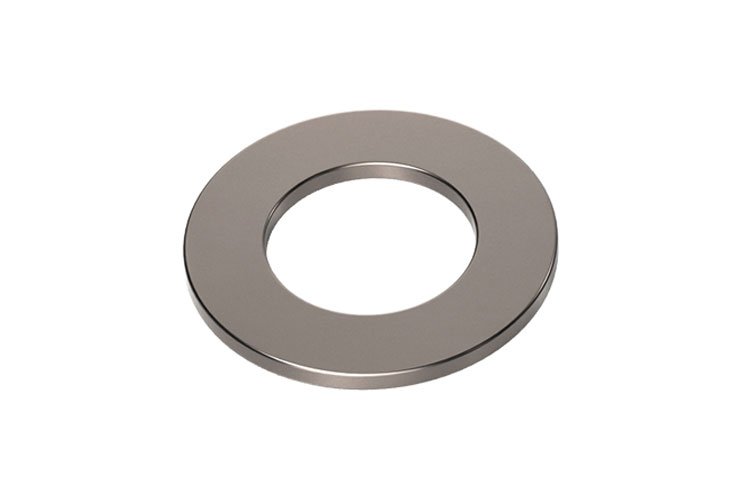
Titanium Flat Washer
Titanium
Titanium (Ti) in high temperature conditions, still has excellent corrosion resistance, in a wide range of temperatures and concentration interval, can be resistant to nitric acid, chloride ions and other corrosion. The suitable working temperature of titanium washer is not higher than 1093℃.
Hastelloy
Hastelloy is a nickel-based corrosion-resistant alloy, the main components are nickel-chromium alloy and nickel-chromium-molybdenum alloy two kinds of corrosion resistance and good thermal stability. Commonly used in the production of washers Hastelloy Hastelloy B-2 (00Ni70Mo28), Hastelloy C-276 (00Cr16Mo16W4) two kinds. These two types of washers are suitable for the working temperature can not exceed 1093 ℃.
Other nickel-based alloys
Inconel600 nickel-based high-temperature alloy belongs to a nickel-cobalt-aluminum system of metals, high temperature, corrosion resistance, high strength, its composition has 77% nickel (Ni), 15% chromium (Ni), 7% iron (Fe). In high temperature conditions, its strength is still very high, mostly used to solve the problem of stress corrosion on the equipment, in low temperature conditions, but also still has superior processing performance.Inconel600 alloy washer suitable working temperature can not exceed 1093 ℃.
Monel 400 alloy is a nickel-based alloy material with good corrosion resistance in a variety of media such as seawater, chemical solvents, ammonia-sulfur-chlorine, hydrogen chloride, sulfate-acid-phosphate, and various other acidic media, alkaline media, salt and molten salt. The maximum continuous working temperature of the washers of Monel 400 alloy should not exceed 815°C.
Summary
When selecting washers, it’s crucial to consider not only the material (metal or non-metal, stainless steel or carbon steel) and specifications, but also the specific working conditions and intended use.