Stud Bolt is a highly frequently used fastener in the industrial field. It is mainly used to achieve functions such as equipment assembly, flange sealing and pre-tightening force. This article will give a concise and systematic introduction to the main characteristics of stud bolts from the aspects of definition, structure, characteristics, material standards and applications, etc., to provide practical reference for engineering, procurement and maintenance personnel.

What Is a Stud Bolt?
Stud Bolt has external threads on both ends and a section of unthreaded smooth rod in the middle. The threads at both ends can be in the same direction or reverse, the length of the threads at both ends can be equal or unequal, and the thickness of the screws also differs.
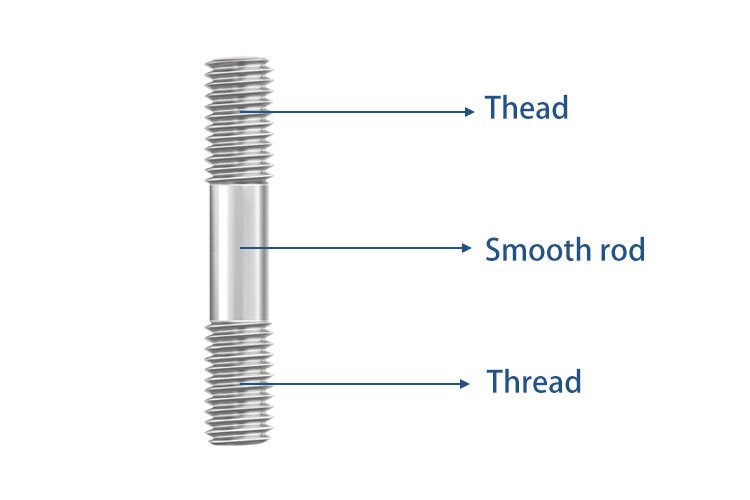
- Equal length studs: Used for connecting with nuts at both ends or for spacing.
- Unequal length studs: used for screwing one end into the body of a component for connection or fastening.
Double-ended studs are also known as double-ended bolts, double-ended screws, or half-threaded double-ended bolts. However, we often refer to larger double-ended studs as double-ended bolts and smaller ones as double-ended screws.
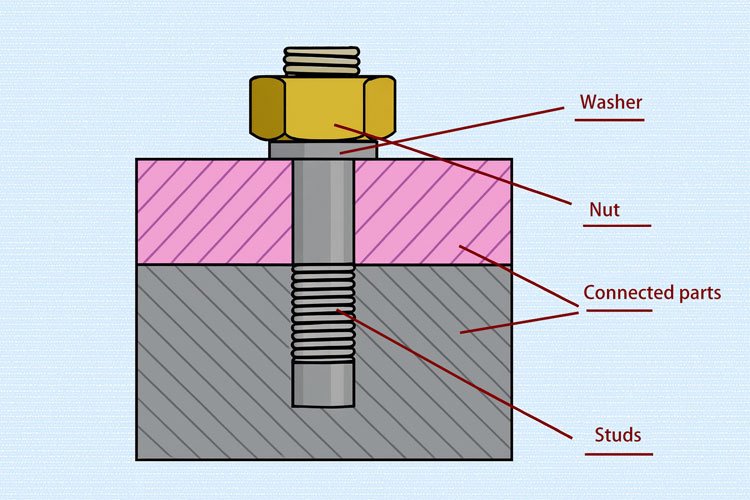
Unlike ordinary bolts, stud bolts do not have hexagonal heads or cylindrical heads. This structural design allows them to connect different components from both sides. One end is usually screwed into the main body of the connected part with internal threads, and the other end is fixed with a nut through the connected part to form a stable mechanical connection.
Double-ended studs are used for fastening connections between flanges, equipment, and structural components. It is the basic connectors for mining machinery, bridges, automobiles, motorcycles, mechanical equipment, chemical industry, wind power, oil and gas, boiler steel structure, crane towers, large-span steel structures and large buildings.
Reference Standard
- GB:GB897、GB898、GB899、GB900、GB901、GB953、GB9125、GB9125.1, etc.
- DIN:DIN797、DIN835、DIN938、DIN939、DIN940、DIN949、DIN2509、DIN2510、DIN6379, etc.
- ASME:ASME B 18.31.1M、ASME B 18.31.2, etc.
Characteristics of Studs
Stud bolts have many advantages. They can provide high-strength connections and are more suitable in conditions that need to withstand heavy loads. The installation of stud bolts is relatively simple. After drilling the hole, insert the bolt and then rotate it, so that the fastening connection can be completed quickly. They can be reused and can be disassembled and installed multiple times. Later maintenance and replacement are very convenient. The double-ended design can also ensure the stability and safety of the connection. Stud bolts can be used for connections of various materials, such as metal, wood, concrete, etc.
The most typical use of stud bolts is in working conditions where ordinary bolts cannot connect, such as thicker connections that require the use of anchor bolts or similar anchor bolts; and in conditions where the main body is large equipment, it is more convenient to use stud bolts.
- High temperature, high pressure conditions
- Corrosive conditions
- Reliable preload
- Ease of maintenance
- Uniform torque
Types of Stud Bolts
Beyond Fastener is a factory specializing in the production of fasteners and parts. There are more than 100 product material grades. The products have many advantages such as high strength, high precision, high temperature resistance, corrosion resistance, high pressure resistance, wear resistance, and use in complex working conditions.
Beyond Fastener can produce studs and nuts, flat washers, spring washers, etc. and can provide a complete quotation. In addition, the material and surface treatment can be customized according to customers’ requirements. We have our own heat treatment production line, which is fully independent of the key processes of heat treatment of fasteners. At the same time, we have the ability of chemical analysis, mechanical properties, metallographic analysis, to give customers authoritative quality assurance.

Both Ends Equal Stud
Both ends of the thread length is the same, equal length stud both ends of the threads need to be with the nut, washer with, for two with through-hole connected parts. This form of connection is called stud connection, also belongs to the detachable connection

Unequal Thread Stud
Unequal length double -ended bolts with a short thread on one end and a long thread on the other, with one or two connecting nuts. Diameters from M10 to M100, lengths on request.
Stud Bolt Material
| Material | Grades | Characteristic |
|---|---|---|
| Carbon Steel | Q235, 35#, 45# | Low cost |
| Alloy Steel | 35CrMo, 42CrMo | High strength, fatigue-resistant |
| American Standard Alloy Steel | A193 B7, B7M; A193 B8, B8M, B16 | High Temperature and Pressure SpecificClick to apply |
| Stainless Steel | 304, 316, 316L, 304L, 316L, A2-70, A4-80 | Corrosion-resistant, moisture-resistant |
| Nickel Alloy | Inconel 600/625, Monel | Extreme operating conditions |
| Duplex Steel | 2205/2507 | High strength + corrosion resistance |
Surface Treatment
- Black Oxide
The principle is to place the bolt in a high-temperature alkaline solution, so that the surface generates a layer of black iron tetraoxide (Fe₃O₄) film, with a thickness of 0.5-1.5μm.
① Basic rust prevention, forming a dense oxidized layer in dry environments, blocking air and moisture contact;
② Reduced costs, simple process and no complex equipment, suitable for mass production;
③ Improved appearance consistency with a black film that hides processing marks.
Applicable scenarios: General mechanical housing connections, low load bolts in dry indoor environments, such as double head bolts for fixing machine tool accessories.
- Phosphating
By reacting phosphoric acid with the metal, a crystalline phosphate film (e.g. zinc phosphate, manganese phosphate) with a thickness of 5-20 μm is produced on the surface.
① Medium anti-corrosion, the porous structure of the film can adsorb anti-rust oil, forming “film + oil film” double protection;
② Enhance the adhesion of the coating, as a base layer for subsequent painting and oiling, to avoid the coating from falling off;
③ Friction-reducing lubrication reduces threading wear during assembly and protects the accuracy of the screw threads.
Suitable applications: General-purpose bolts for automotive chassis and steel structural components requiring secondary coating, often used in conjunction with blackening processes.
- Hot-Dip Galvanizing
The bolts are immersed in molten zinc at 440-460°C, forming a composite coating consisting of a zinc-iron alloy layer (0.01-0.03 mm) + a pure zinc layer (0.02-0.06 mm).
① Strong corrosion resistance: The zinc layer provides sacrificial anode protection to the substrate, reducing corrosion rates by over 60% in humid and outdoor environments.
② Longer lifespan, lasting 10-15 years under normal conditions—3 to 5 times longer than blackened finishes.
③ Resistant to impact wear, with a tightly bonded coating to the substrate, capable of withstanding the vibration and impact forces encountered in mining machinery.
Applicable scenarios: High-humidity environments such as connecting bolts for mining jaw crushers, foundation bolts for wind turbine towers, and outdoor steel structure fasteners.
- Dacromet (zinc-chromium coating)
Using zinc powder and chromic anhydride as core components, an inorganic composite coating with a thickness of 5-12μm is formed on the surface through a coating-baking process.
① Exceptional corrosion resistance, achieving 500-1000 hours in neutral salt spray tests—3 to 5 times longer than standard galvanized coatings;
② No risk of hydrogen embrittlement, with baking temperatures around 300°C, preventing high-strength bolts (such as Grade 10.9) from fracturing due to hydrogen embrittlement;
③ Resistant to high and low temperatures, with no peeling or brittleness in environments ranging from -50°C to 300°C.
Applicable scenarios: Aero-engine intermediate casing studs, Offshore platform connectors, Bolts in high-temperature corrosion areas of chemical equipment.
- Teflon (PTFE-coated, polytetrafluoroethylene)
A PTFE film with a thickness of 2–5 μm is formed on the surface via spraying or dip coating.
① Ultra-low friction coefficient (0.02–0.04) significantly reduces thread wear during assembly and extends the lifespan for repeated disassembly.
② Anti-adhesion and corrosion-resistant, capable of withstanding strong corrosive media such as acids, alkalis, and organic solvents;
③ Prevents loosening and slippage, enhances the self-locking capability of threaded pairs, and adapts to vibrating environments.
Applicable scenarios: Engine cylinder head bolts for automobiles, connecting bolts for chemical reactor vessel seals, and fan bolts subjected to high-frequency vibration.
| Item | Features | Corrosion Resistance Rating |
|---|---|---|
| Electrogalvanizing | Low cost | ★★ |
| Hot-Dip Galvanized | Outstanding outdoor corrosion resistance | ★★★★ |
| Dacromet | Salt spray 500 hours+ | ★★★ |
| Black Oxide | Rust-proof + High-temperature resistant | ★★ |
| Fluorocarbon | Strongly acidic or alkaline environments | ★★★★★ |
| Nickel-based coating (Xylan) | Excellent corrosion resistance for offshore engineering | ★★★★★ |
Stud Manufacturing Process
First comes straightening, where a straightening machine corrects the distortion in the material. Only after this process can the next step proceed. The next step involves using a cutting machine to trim the long, straightened material to the customer’s specified length, completing the second process. The third process involves placing the cut short pieces on a thread rolling machine to roll out the threads. At this point, the standard double-headed bolt is complete. Of course, if additional requirements exist, further processing steps will be necessary.
Precautions for Using Double-Ended Bolts
Preparation and Inspection Before Installation
Visual Inspection: Before installation, carefully inspect the double-headed bolts for deformation or damaged threads. Replace any defective bolts.
Cleaning procedure: Ensure threaded surfaces are free of oil, rust, burrs, and contaminants. Use a specialized thread cleaner when necessary to guarantee connection strength and accurate preload.
Tool Preparation: Prepare appropriate tools according to bolt specifications, such as specialized tools like TORX sockets E8 and E10. For high-strength bolt connections, a calibrated torque wrench should be prepared.
Proper Installation Methods and Torque Control
Installation sequence: For multi-bolt connection structures, tighten bolts symmetrically in stages to avoid deformation caused by excessive stress on one side.
Torque Control: Tighten strictly according to the torque values specified in the design. Typical torque values include:
Double-ended bolt A: 9.5 Nm (97 kgf·cm, 84 in·lb)
Double-ended bolt B: 21 Nm (214 kgf·cm, 15 ft·lbf)
Stepwise tightening: Critical connections must be tightened in stages, such as pre-tightening to 20 Nm followed by final tightening to 40 Nm. Any bolt failing to meet the specified torque must be replaced and retightened.
Special Process: In high-temperature or vibration environments, heat treatment or axial high-frequency vibration may be employed to assist assembly, thereby enhancing installation strength and stability.
Why Do Double-Ended Bolts Need Maintenance?
Double -ended bolts are mostly used in large-scale equipment, in the actual operation of the equipment, under the influence of external load vibration and temperature changes, the friction will be reduced, with the continuation of the working time, the threaded connection will produce loosening until failure. For this reason, in the use of Double -ended bolts connection, to do a good job of maintenance.
During routine equipment inspections and maintenance, double-headed bolts and other components must be examined at every service interval. When inspecting bolts, rigorously check the bolt head and guide sections for defects, including cracks or indentations in the threads, altered thread profiles, or abnormal pitch. Replace double-headed bolts immediately if any issues are detected.
Daily Maintenance of Double-Ended Bolts:
- Prevent double-ended studs from contact with corrosive substances such as acids and alkalis.
- Regularly clean double-ended studs to remove surface dust and grime.
- When using double-ended studs, avoid prolonged tightening to prevent bolt deformation or cracking.
- Store double-ended studs in a dry, well-ventilated area to prevent moisture corrosion.
- If rust appears on double-ended studs, promptly treat it with a rust remover.
- When installing double-ended studs, select specifications matching the original bolts to ensure stable connections.
What Are Double Ended Studs Used For?
Double -ended studs its length is usually greater than the head of the bolt, so more for the connection of equipment with a higher thickness, as well as the inconvenience of ordinary bolts connected to the conditions, such as thick plates and concrete roof racks, roof beams hanging, monorail beams hangers, etc. will be used to connect the Double -ended bolts, as well as high pressure, high temperature, high temperature change of the premises are also more than Double -ended bolts.
Like bridge automobile, mining machinery, boiler post, motorcycle, crane tower, large span steel structure, large buildings and other areas of large equipment, such as reducer frame, mechanical seal seat, etc. are commonly used Double -ended bolts, because many large equipment accessories are to be frequently disassembled, the threads are prone to wear and tear or damage, the use of good replacement of the Double -ended bolts is more convenient.
- Mining Machinery
In the high-load, high-impact operating environment of mining machinery, thick-rod double-ended bolts are key connecting components to ensure stable equipment operation.
These bolts are manufactured from high-alloy structural steel and undergo quenching and tempering heat treatment to achieve tensile strengths exceeding 1000 MPa. Their surfaces are typically coated with hot-dip galvanizing or Dacromet. In humid, dusty, and highly corrosive environments, they can reduce corrosion rates by over 60%, extending their service life by 3 to 5 times compared to standard bolts.
- Connection of the moving jaw to the frame in jaw mining machinery
- Fixed chain pitch in scraper conveyors
- Installation of ball mill liners
- The failure rate of mechanical connections using such bolts can be reduced to below 2%, significantly lowering operational and maintenance costs.
- Aerospace
Double-ended studs are widely used for connecting critical components such as the intermediate casing unit in aircraft engines.
Due to the high-temperature, high-pressure, and continuous vibration characteristics of the operating environment, extremely high reliability is demanded of double-ended studs. Research indicates that the primary cause of loosening and disengagement of double-ended studs in aeroengines is that the self-locking nut’s breakaway torque exceeds the installation torque of the mating double-ended stud. Furthermore, high temperatures in the flow channels and engine vibration significantly accelerate fatigue failure.
By adopting an assembly process combining temperature difference and vibration (preheating studs followed by axial high-frequency vibration during tightening), the average failure rate due to stud loosening for double-ended studs was reduced from 21.6% to 3.2%.
- General Industry
In general industrial manufacturing, double-headed bolts are commonly used for:
- For large equipment requiring attachment installation (e.g., sight glasses, mechanical seal seats, gear reducer frames, etc.)
- Precise connections between heavy-duty machine tool components ensure stability and accuracy during high-speed operation and complex working conditions
- Critical applications in the automotive industry include engine block-to-head connections and chassis component fastening
The advantage of double-ended bolts lies in their ability to prevent wear or damage to the main thread caused by frequent disassembly when attachments require regular removal, making replacement and maintenance more convenient.
Frequently Asked Questions (FAQ)
Q1:What is the difference between a double-headed bolt and a fully threaded rod?
- Double-headed bolts have clear standards and corresponding material requirements.
- Full-threaded rods are primarily used in light-load applications, where mechanical properties may not need to meet high-strength requirements.
Q2:Can double-headed bolts be reused?
Reuse is not recommended in high-temperature and high-pressure scenarios; at ambient temperatures, reuse may be evaluated based on specific circumstances.
Q3:How do you calculate the length of flange bolts?
Calculations can be performed based on flange thickness, gasket thickness, and nut height. I can provide the calculation formula and example diagrams.
Q4:Why does B7 require 2H nuts?
Due to strength matching, otherwise there is a risk of fracture.
Q5:Why do stainless steel bolts seize up?
Lubrication-free + cold welding effect.
Summary
In the high-load, high-impact operating environment of mining machinery, coarse-rod double-ended bolts serve as critical connecting components that ensure stable equipment operation.
Double-headed bolts, though structurally simple, serve as fundamental components supporting modern industry. Selecting appropriate materials and dimensions, along with proper installation and maintenance, not only ensures safe and reliable equipment operation but also extends equipment lifespan and reduces overall costs.