What Is a Hex Flange Bolt?
A hexagonal flange bolt is a bolt consisting of a hexagonal head, a flange, and a threaded shank (a cylindrical object with external threads). It is used with a nut to fasten two parts that pass through a hole. This type of connection is called a bolted connection. If the nut is unscrewed from the bolt, the two parts can be separated, so bolted connections are detachable connections.
Currently, the commonly used standards in the market are: flange bolts GB5789, GB5787, DIN6921, ISO 4162, JIS1189, IFI111, ASME B18.2.1, ASME B2.3.9, etc.; flange nuts DIN 6923.
BD Fastener (Beyond Fastener) is a professional flange bolt supplier in China, offering high-quality flange bolts and screws in various specifications and sizes. We provide one-stop fastener solutions to global customers with highly competitive pricing, reliable delivery schedules, and comprehensive technical and after-sales support. If you are seeking a supplier, manufacturer, or bulk purchasing options, we are your trusted partner.

What Are the Characteristics of Flange Bolts?
Standard bolts have thick heads that resist deformation and tend to loosen after tightening.
Compared to standard bolts, hex flange bolts feature a larger ratio of bearing surface area to stress area, enabling them to withstand higher preload forces and offering superior anti-loosening performance. They effectively distribute loads and reduce surface indentations on workpieces. Characterized by precise assembly and high durability, they can replace the combination of standard hex bolts and washers. With high assembly efficiency, they are suitable for mass production lines.
Types of Hex Flange Bolts
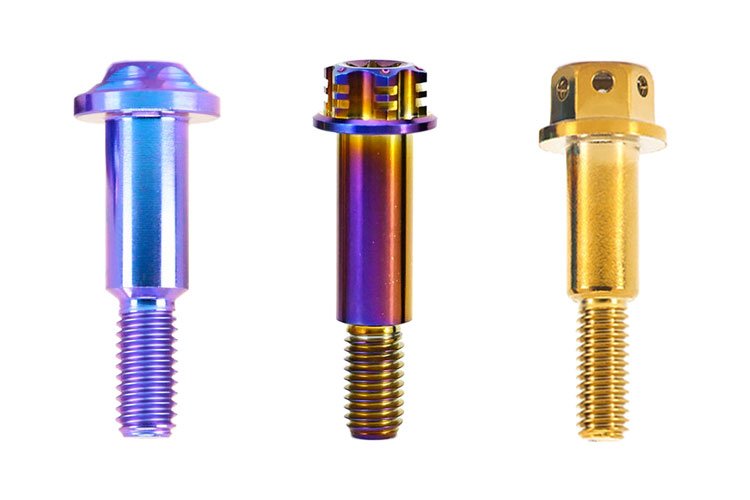
Hex heads come in two types: flat-top and countersunk. Threads are available as full-thread or half-thread. Flanges are categorized as flat-bottom or serrated; serrated flanges feature fine, dense teeth for anti-slip functionality, making them suitable for vibrating applications such as automotive chassis, compressors, and industrial machinery.
Flange bolts also have reamed holes designed to withstand lateral forces. Bolts with holes in the shank prevent loosening under vibration. Some flange bolts feature a slender shank, termed fine-shank flange bolts, which are advantageous for connections subjected to variable forces. Structural steelwork employs specialized high-strength bolts with larger heads and varying dimensions.

Flange Hex Bolts for Automobile

Brass Serrated Flange Bolt

Carbon Steel Flange Bolt

Dacromet Flange Bolt
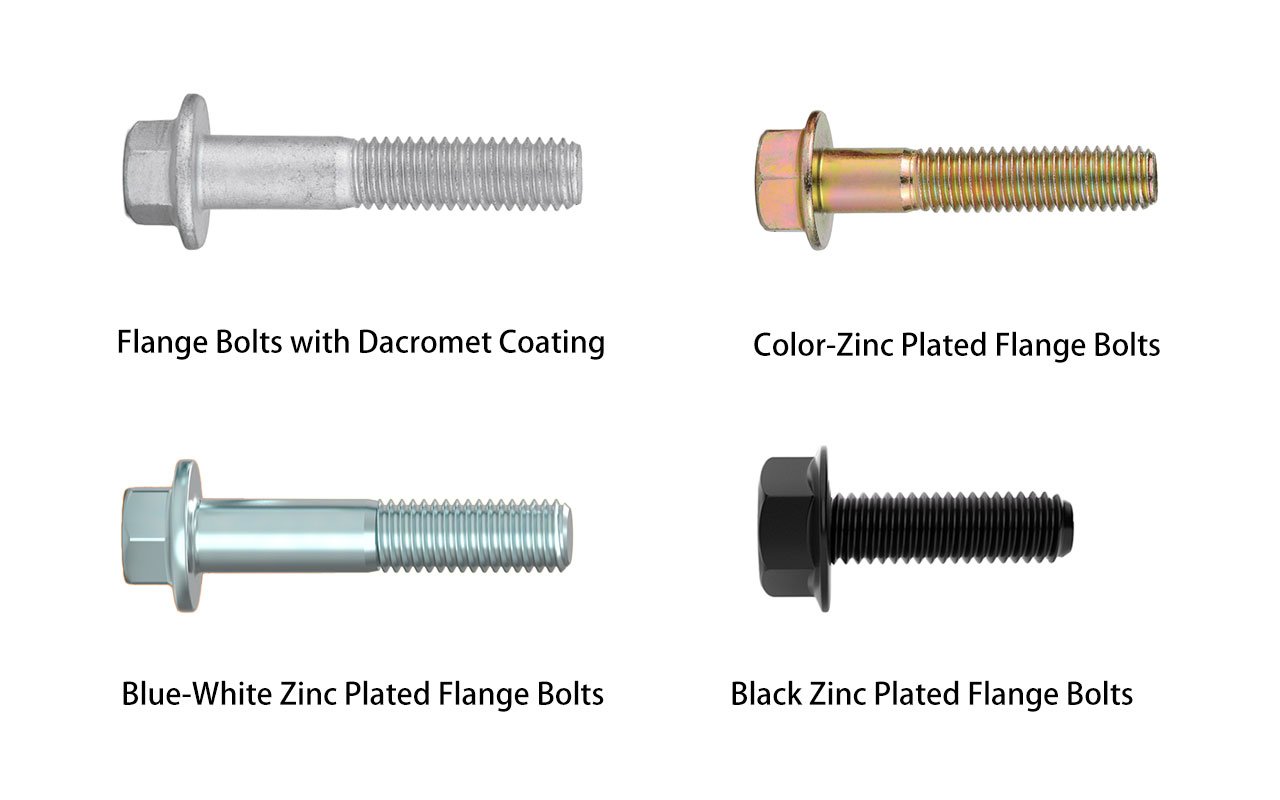
Surface Treatment and Color
Depending on specific requirements, surfaces are available with white zinc plating, blue-white zinc plating, army green, black zinc plating, yellow zinc plating, nickel plating, chrome plating, black oxidation, hot-dip galvanizing, phosphating, and corrosion-resistant Dacromet coating.
| Surface Treatment | Color | Corrosion Resistance |
|---|---|---|
| Blue Zinc | Silver-white | ★★★ |
| Rainbow Zinc | Rainbow colors | ★★★ |
| Black Zinc | Black | ★★★ |
| Black Oxide | Black | ★ |
| HDG | Silver-gray | ★★★★★ |
| Dacromet | Grayish white | ★★★★★ |
| Nickel plating/Chrome plating | Silver-bright | ★★ – ★★★ |
| Phosphating | Dark Gray/Black | ★★ |
Note: The more severe the environment, the more corrosion-resistant the treatment method should be selected.
Common Materials for Flange Bolts
- Carbon Steel (4.8, 8.8, 10.9, 12.9)
- Alloy Steel (SCM435, 10B38)
- Stainless Steel (A2-70, A4-70, A4-80)
- Copper, Copper Alloys
- Titanium Alloy (Aerospace Grade)
Why Hexagonal, And Not Something Else?
Many people wonder why bolts are designed with a hexagonal shape and not others. The hexagon is the result of a compromise between the side length and the required turning angle.
For bolts with an odd number of sides, the two sides of the wrench are not parallel. If it’s a four-cornered bolt, the wrench needs to be turned 90 degrees to tighten it, which is not suitable for installation in confined spaces. If it’s an octagon or decagon, although the turning angle becomes smaller, the force applied is less, making it easier to wear down and become rounded.
Therefore, the hexagonal shape is a common choice for bolts.
Uses
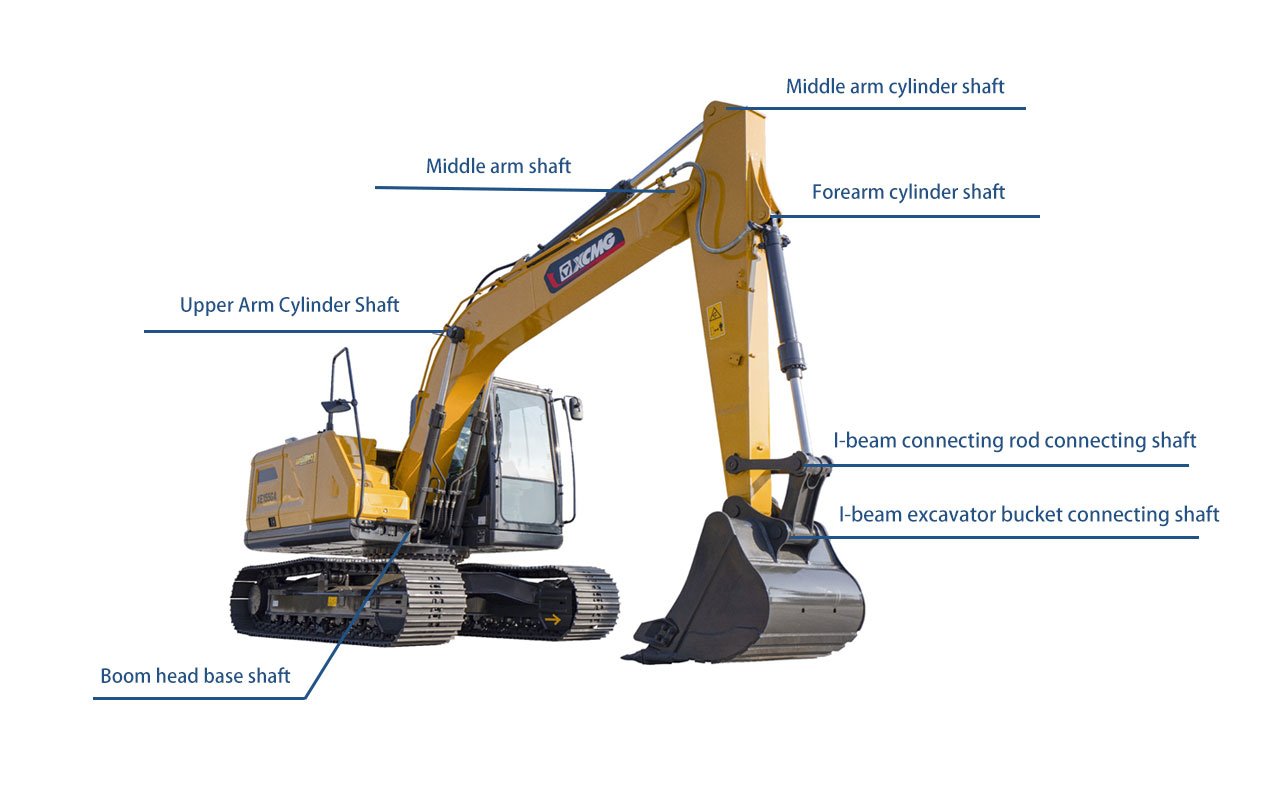
The requirements for hexagonal flange bolts vary depending on the application. Generally speaking, hexagonal flange bolts are widely used in industrial and civil buildings, automobiles, cranes, excavators and other heavy machinery.
Let’s unlock the applications and mysteries of excavators together!

The force-bearing method of excavator bolt connections can be distinguished into ordinary and reamed hole types. Flange bolts used for reamed holes have holes in their shanks to prevent them from loosening when subjected to vibration.


In addition, there are some special bolts on the excavator, high strength and toughness requirements, you need special materials and special processing technology. Such as engine crankshaft bolts, cylinder head bolts, connecting rod bolts, flywheel bolts, nozzle fixing bolts, 12.9 grade bucket bolts and so on.
Corrosion Protection and Sealing for Bolted Joints To prevent plastic deformation under external tension, a primer (e.g., epoxy resin, zinc powder) may be applied to the contact surfaces of bolted joints, or the bolts themselves may be coated.
In response to evolving market demands, hex flange bolts have spawned various new variants. These include cross-recessed hex head bolts, hex flange wood bolts, hex flange triangular thread self-locking bolts, hex flange face self-tapping self-drilling bolts, and hex flange self-tapping self-drilling bolts (with coating + EPDM composite washer).
Summary
Hex flange bolts are a type of industrial fastener characterized by reliable structure, efficient installation, and broad applicability. Combining the high strength of a hex head with the stability of a flange washer, they deliver outstanding performance in various vibration scenarios and high-strength connections.