In a vibrating environment, the loosening of fasteners is like an “invisible bomb” that may cause equipment failure at any time. Today, BD Fastener shares a hardcore comparative test on the anti-loosening performance of 8 nut combinations to help you find the most suitable anti-loosening solution.


Cause Analysis
Nut loosening is caused by tension, extrusion, and torsion, and vibration conditions combine these factors. Vibration is like an invisible force repeatedly “pulling,” “compressing,” and “torquing” the joint surfaces of the bolt and nut:
- Tension: The axial force of the tension stretches the bolt, causing it to elongate.
- Extrusion: Extrusion deforms the thread profile, causing the thread gap to increase.
- Torsion: The reverse torsion under vibration generates tangential forces, causing the nut or bolt to rotate loose.
The combined action of these forces causes relative movement of the bolt or nut, which reduces friction and ultimately leads to loosening.
Locking Solutions
How to solve the above problems? To reduce loosening, the following three aspects are usually addressed:
- Increasing contact area and friction: Increase thread contact area and friction by adjusting the lead angle, flank angle, and lead-in taper.
- Chemical bonding: Use chemical adhesives to prevent relative movement between threads.
- Mechanical locking: Increase friction or limit movement through special mechanical structure design.
Lock Nut Types
For the vibration loosening problem, the following several typical nut combination solutions can be referred to:
- Double nut: The cooperation of two nuts generates additional friction to prevent loosening.
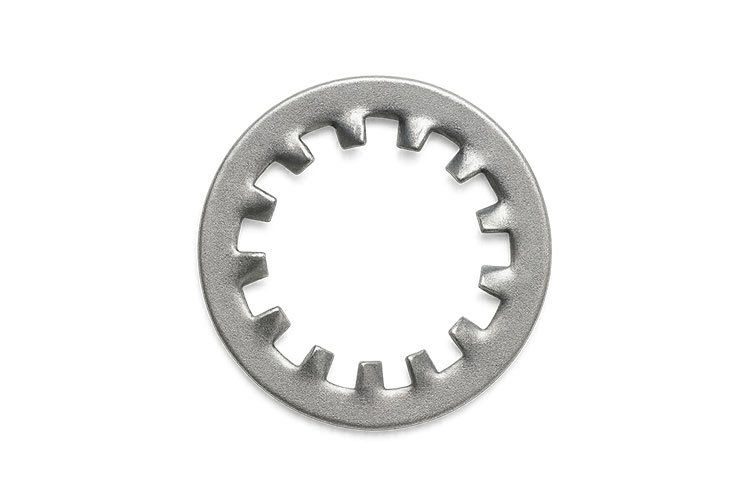
- Washers: flat washers/spring washers/toothed washers/nylon washers, which are designed to disperse pressure and increase friction.
- Nylon locking nut: with nylon insert, using the elasticity of nylon to increase friction to reduce relative sliding.
- Chemical Adhesive Lock Nut: This type uses a chemical adhesive to prevent the nut from loosening.


Anti-Loosening Test
By simulating a vibration environment and monitoring the changes in clamping force in real time, the anti-loosening effect of each nut combination can be accurately evaluated.
Test equipment
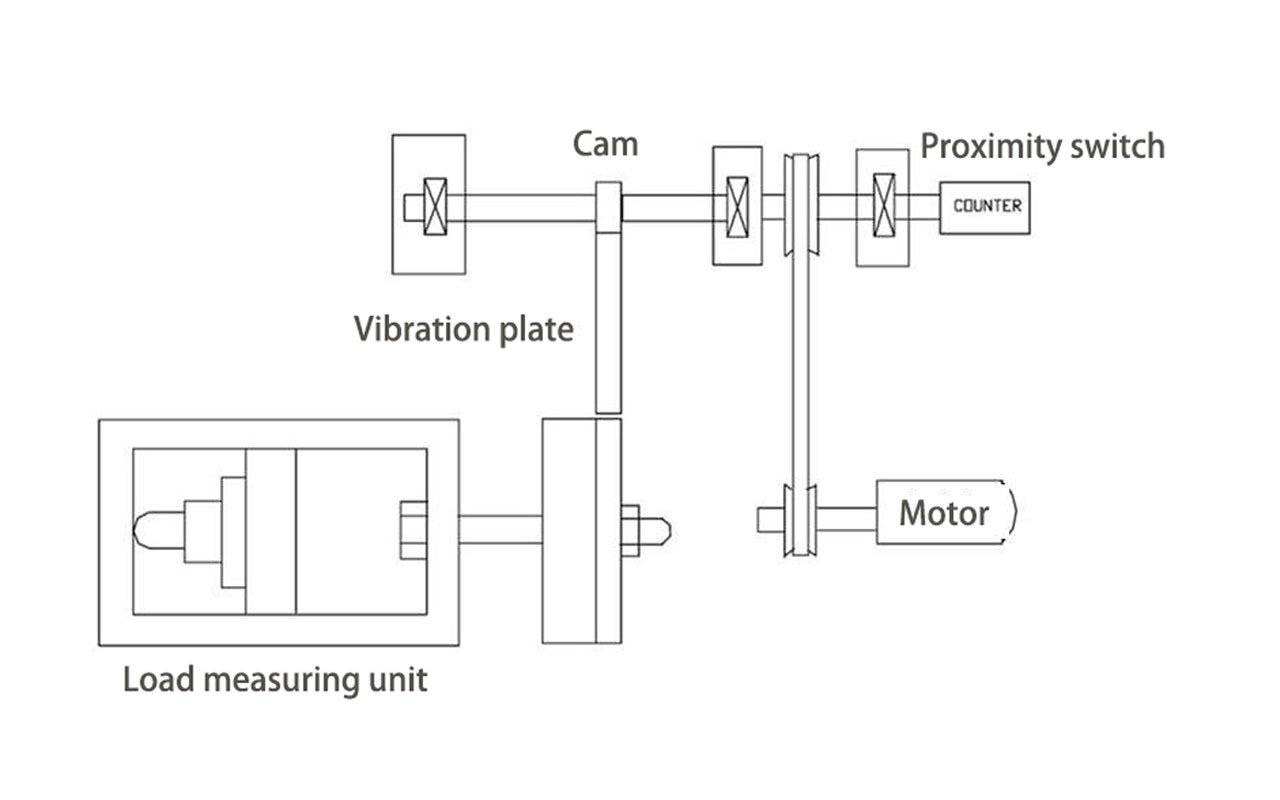
The test device for anti-loosening performance is generally composed of a motor, a cam mechanism, a load measuring unit, a vibration transmission mechanism, etc.:
- Motor: Provides stable rotational motion.
- Pulley: Transmits the motor’s rotational motion to another shaft, ensuring efficient power transmission.
- Cam mechanism: installed on the rotating shaft, converts the rotational motion into a swinging motion with a fixed frequency.
- Load measurement unit: Measures the clamping force between the two plates clamped by the bolt under test.
- Proximity switch: Accurately counts vibrations by recording the number of shaft rotations.
Vibration transmission mechanism: Transmits vibrations to the test piece. By adjusting the pulley step, the vibration frequency can be changed to simulate vibration environments of different intensities.
Test samples
The test was conducted based on two high-strength bolts with eight different nut and washer combinations.
| Bolt types | Specifications | Pitch | Nuts and washers |
|---|---|---|---|
| Metric bolts | M16 | 2mm | Ordinary nuts, flat washers, spring washers, internal tooth washers, external tooth washers, double nuts, nylon lock nuts, nylon washers, chemical glue lock nuts. |
| Metric bolts | M10 | 1.5mm |
Test parameters
The vibration amplitude at the end of the vibrating plate was 0.175 mm, and the vibration frequency was 3 Hz. At least 10,000 vibration cycles were performed for each combination. The measurement unit collected test data in real time.
To ensure the reliability of the results, all experiments were repeated three times to obtain average data and reduce the impact of random errors.
Test Results
After the test, the loosening behavior of different nut and washer combinations on M16 and M10 high-strength steel bolts, as well as the effects of different initial clamping forces on bolt loosening, were collected, collated, and analyzed.
Real-time clamping force changes of different nut combinations on M16 high-strength steel bolts:
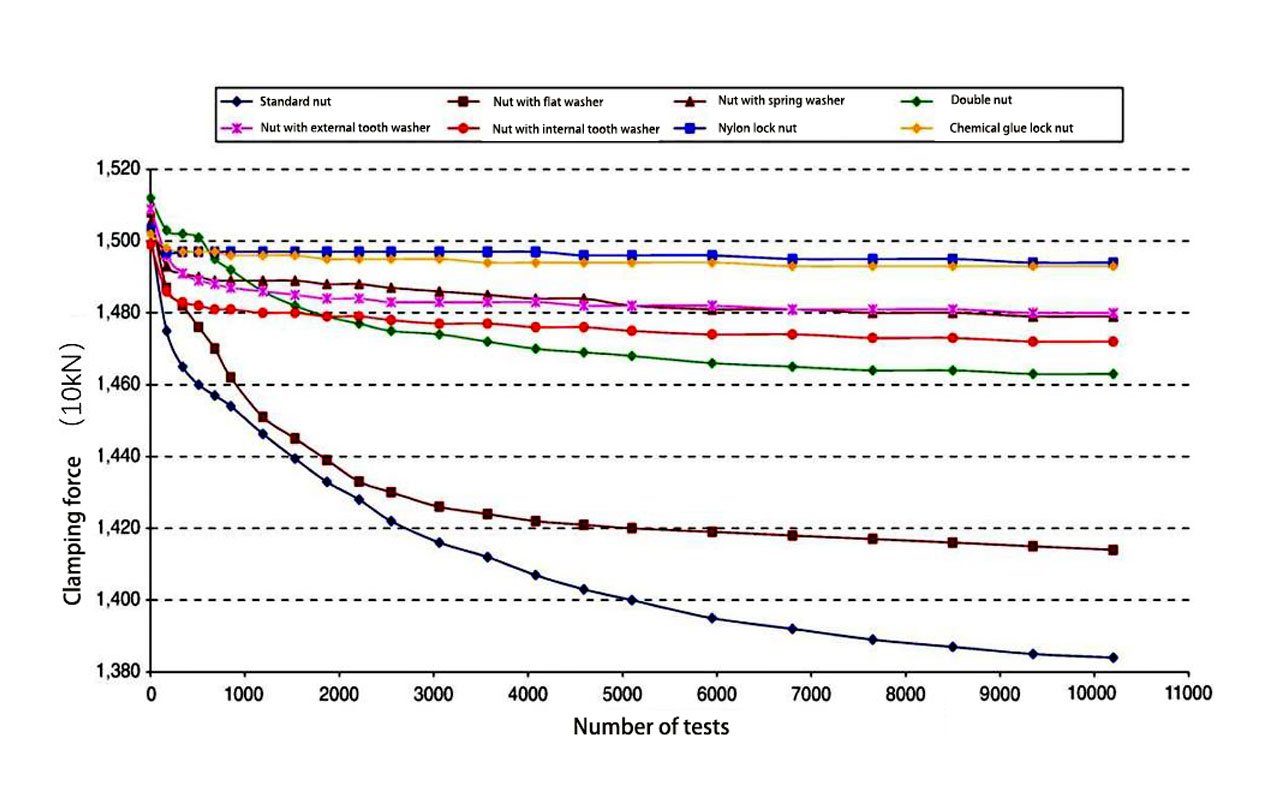
Based on the standard nut, the anti-loosening performance of the flat washer is slightly improved, but the effect is limited.
Double nuts, toothed washers, spring washers, metal lock nuts, and nylon lock nuts all effectively reduce loosening, with significant results. Nylon lock nuts performed particularly well in the tests.
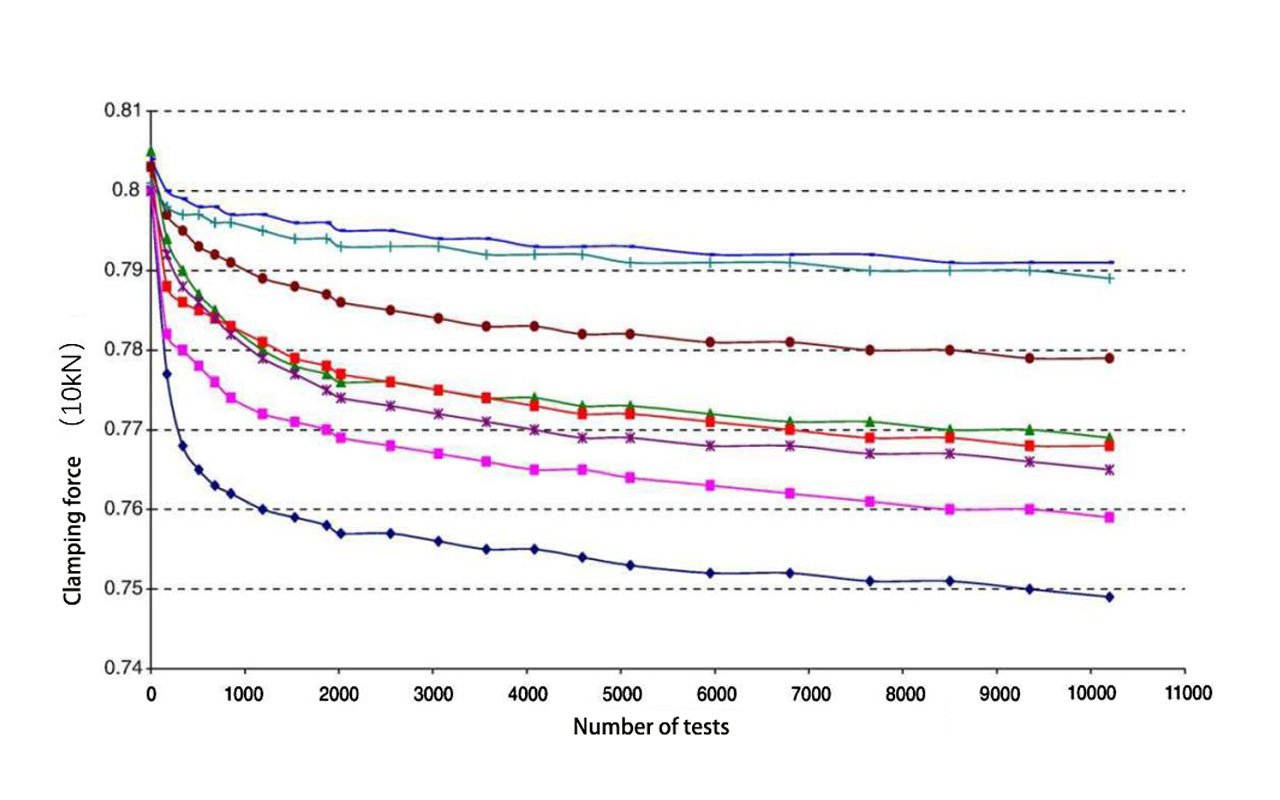
Loosening of different nuts on M10 high-strength steel bolts:
The anti-loosening performance of flat washers is slightly improved, but the effect is limited; external tooth washers/spring washers/nylon washers can all effectively reduce loosening; double nuts have a more obvious advantage; nylon locking nuts and chemical adhesive locking nuts performed the best in the test.
Analysis of the effect of different initial clamping forces on the loosening of M16 high-strength steel bolts:
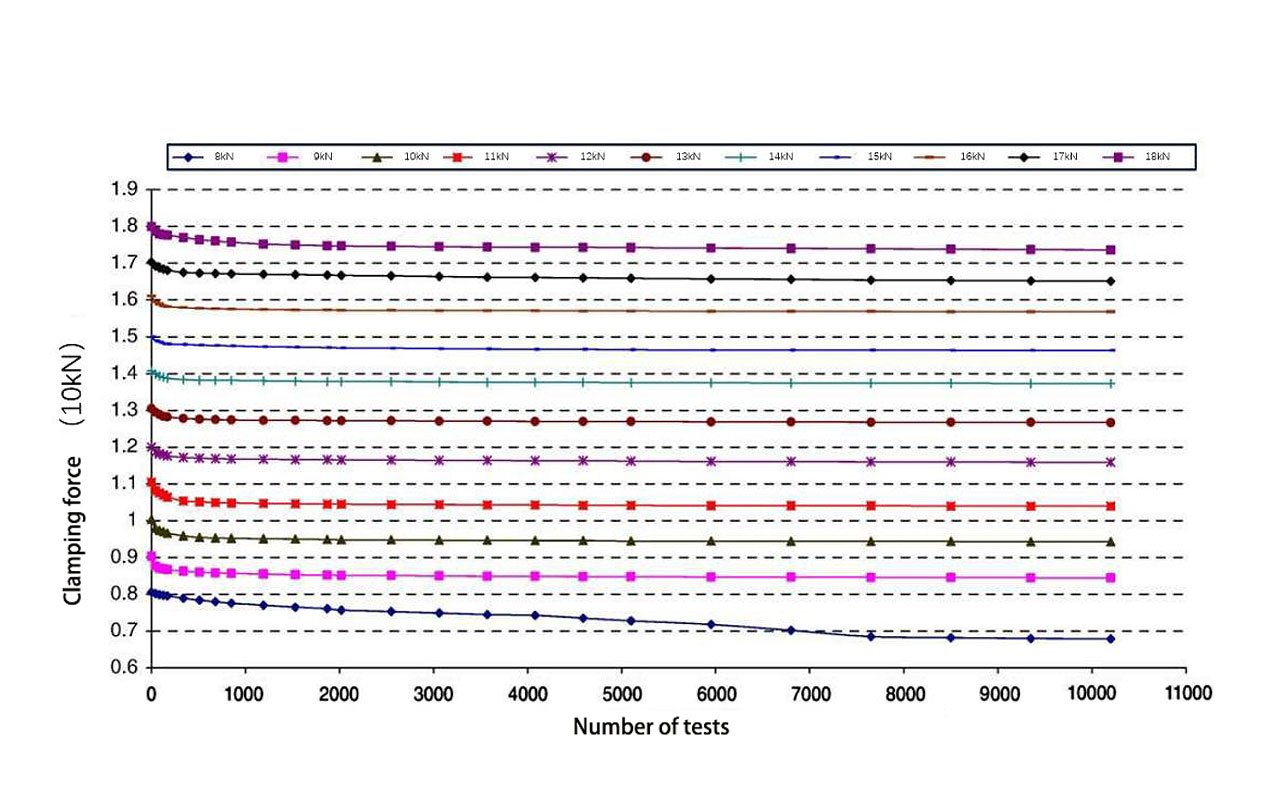
The loosening trends are almost the same for all initial clamping forces. The loosening rate calculation of the clamping force relative to the initial clamping force after 10,200 cycles is shown in the following table.
| Initial clamping force (10kN) | 8 | 9 | 10 | 11 | 12 | 13 | 14 | 15 | 16 | 17 | 18 |
| Loosening probability (%) | 15.8 | 6.4 | 6.0 | 5.9 | 3.4 | 3.0 | 2.5 | 2.5 | 2.7 | 3.0 | 3.6 |
When the initial clamping force exceeds 11 kN, loosening is minimized. This may be because a higher initial clamping force causes greater deformation of the fastener at the contact point, increasing frictional resistance and thus reducing loosening. However, excessive clamping force may also damage the fastener structure and affect the anti-loosening performance.
Experience and Summary
In anti-loosening performance, not only bolts and nuts play a key role, but fasteners such as washers are equally important. Furthermore, an appropriate initial tightening force is crucial for ensuring fastener stability. Among the various anti-loosening fastening combinations tested, chemical adhesive lock nuts showed the most significant anti-loosening ability, followed by nylon lock nuts.
Through today’s sharing, we hope to provide you with a better understanding of the performance of different locknuts in vibration environments and provide a scientific basis for selecting the appropriate anti-loosening solution.