Grades 8.8, 10.9, and 12.9 bolts are all classified as high-strength fasteners. Their primary differences lie in their mechanical property grades. Selection should be based on a comprehensive evaluation of load requirements, cost considerations, and safety factors for the specific application. There is no absolute “better” or “worse” option—the key is choosing the most appropriate grade for the intended use.
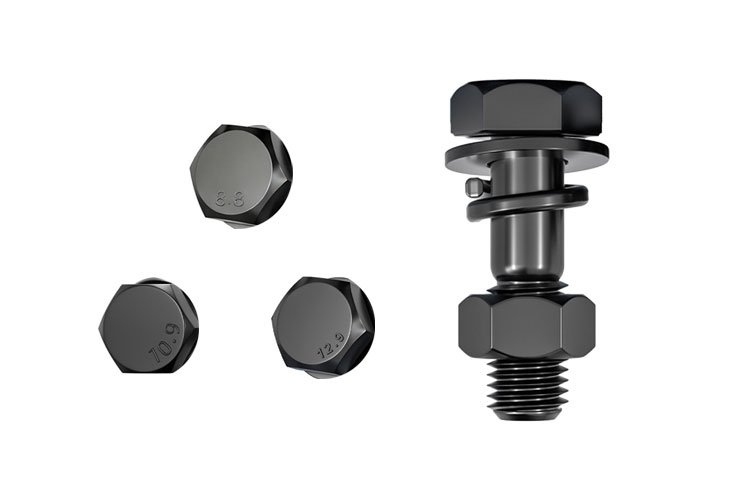
Mechanical Properties Comparison
- Grade 12.9 screws have higher tensile strength and yield strength than Grade 10.9 screws. However, this increase in strength comes at the expense of reduced toughness, which may result in brittle failure under alternating loads or impact conditions.
- Grade 10.9 screws provide a better balance between strength and toughness, making them more suitable for dynamic stress environments, such as vibration and impact.
| Property Class | Tensile Strength (MPa) | Yield Strength (MPa) | Yield Ratio | Characteristics |
| Grade 8.8 | 800 | 640 | 0.8 | Easy to machine, cost-effective, good balance between strength and cost |
| Grade 10.9 | 1000 | 900 | 0.9 | High strength and toughness, excellent fatigue resistance |
| Grade 12.9 | 1200 | 1080 | 0.9 | Extremely high strength, but relatively lower toughness and higher risk of brittle fracture |
Precautions
- Bolt–Nut Grade Matching
The bolt grade should be one level higher than the nut grade (e.g., a Grade 10.9 bolt with a Grade 10 nut) to prevent premature nut failure.
- Material and Manufacturing Quality
Purchase from reputable manufacturers and verified brands. Avoid low-cost, poor-quality products, as excessive impurities or improper processing can lead to brittle fracture.
- Installation Specifications
Install strictly according to the specified torque values (e.g., 120 N·m for an M12 bolt). Insufficient preload may cause loosening, while excessive torque can result in bolt fracture.
- Alternating Load Applications
In applications subject to cyclic or dynamic loads (e.g., fan housing fastening), Grade 12.9 screws may fail due to insufficient toughness. In such cases, Grade 10.9 is preferred.
- Zinc Plating Requirements
If Grade 8.8 screws require zinc plating, they should not be substituted with Grade 12.9 screws, as high-strength fasteners are more susceptible to hydrogen embrittlement during plating.
- Safety-Failure Design
In safety-critical systems (e.g., braking devices), bolts may be designed to fail under specific conditions to protect the system. In such cases, higher-strength bolts must not be used as substitutes.
- Substitution Risks
Replacing lower-strength fasteners with higher-strength ones is generally feasible, provided that nut strength is properly matched (bolt grade one level higher than the nut). However, high-strength fasteners should be avoided in applications with a high risk of brittle fracture.
Applications
Typical Applications of Grade 8.8 Bolts
- Static or low dynamic load applications:General construction fastening, light-duty brackets, and electrical distribution cabinet enclosures.
- Cost-sensitive projects:Non-critical connections, such as standard motor end covers.
- Easy-replacement applications:Furniture assembly and household equipment installation, where the risk of failure is low and replacement costs are minimal.
Typical Applications of Grade 10.9 Bolts
- High dynamic loads:Vibration-intensive environments such as mining machinery and construction equipment, as well as impact loads in automotive engines.
- Extreme safety requirements:Aerospace components, high-pressure pipelines, and large lifting equipment.
- Long-term outdoor exposure:Transmission towers and wind power equipment, where resistance to wind loads and corrosion is required.
Typical Applications of Grade 12.9 Bolts
- Ultra-high-strength applications:Steel structural connections for missile launch platforms and military protective facilities, which must withstand extreme impact forces.
- High-precision machinery:Precision machine tool drive components and aircraft engine parts, where extremely high requirements for both strength and dimensional accuracy apply.
- Special environments:Nuclear power plant equipment and deep-sea exploration devices, requiring exceptional corrosion resistance and high reliability.