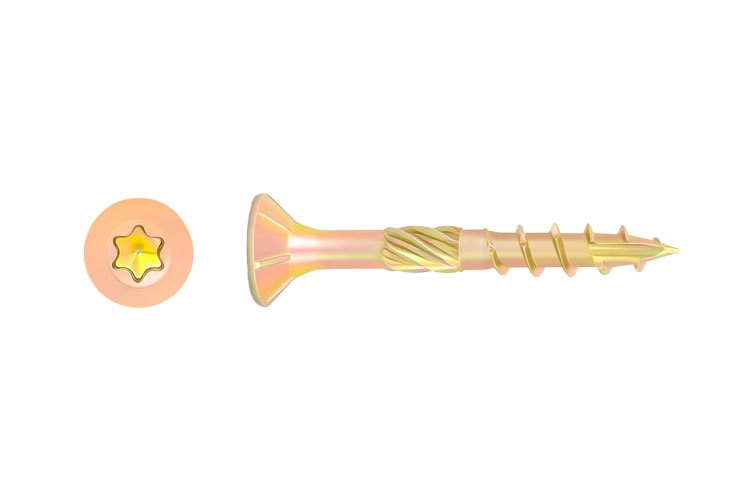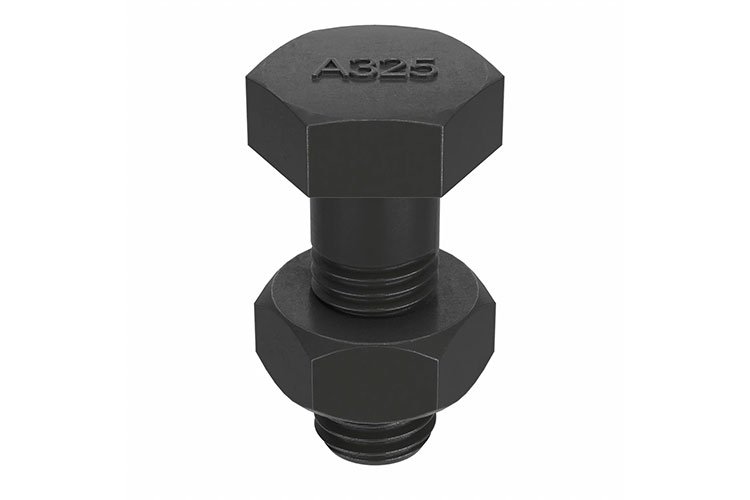
Coarse thread is what we often call standard thread, if there is no special instructions in the procurement of bolts is fine or coarse thread, the default is coarse thread; fine thread and coarse thread compared to the same nominal diameter, each inch contains a different pitch, that is, the number of teeth is different, coarse pitch is large, fine pitch of the thread is small.
For example, for the two sizes 1/2-13 and 1/2-20, the former is a coarse thread while the latter is a fine thread, indicated as 1/2-13UNC and 1/2-20UNF.
Along the direction of the axis, clockwise rotation of the thread becomes right-handed thread, counterclockwise rotation of the thread is called left-handed thread. We understand left and right well, but what is the difference between coarse and fine? Let’s explore the characteristics of these two types of threads.
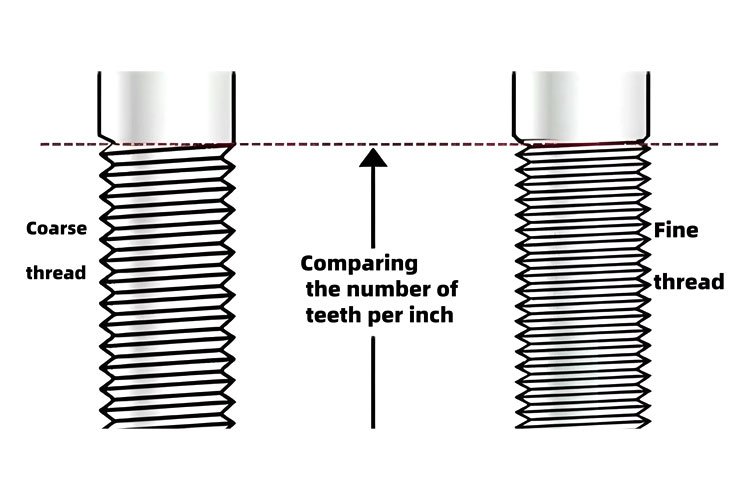
What Is a Coarse Thread?
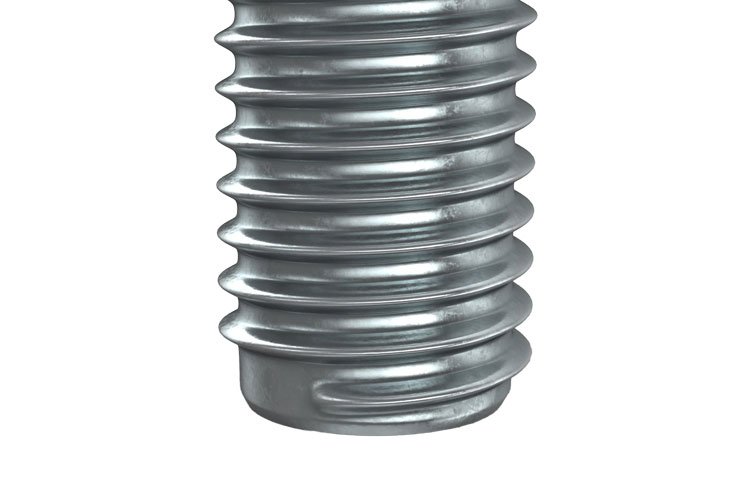
Coarse threads are standard metric threads, which can be found in national thread standards. Most screws and bolts available for purchase are coarse threads. Fine threads also have standards; you can refer to mechanical design handbooks for details.
In the imperial thread system, coarse threads are referred to as Unified National Coarse (UNC) threads.
Characteristics of Coarse Threads
Coarse threads have high strength, good interchangeability, and are available with standards for reference. Generally speaking, coarse threads should be the optimal choice.
Compared with fine thread, due to the large pitch and angle of thread rise, the self-locking performance is poor, and anti loosening washers, self-locking devices, etc. need to be installed in vibration environments; The advantage is that it is easy to disassemble and assemble, comes with a complete set of standard components, and is easily interchangeable.
Coarse threads do not require pitch specification, such as M8, M12-6H, M16-7H, etc., and are mainly used for connecting threads.
What Is a Fine Thread?
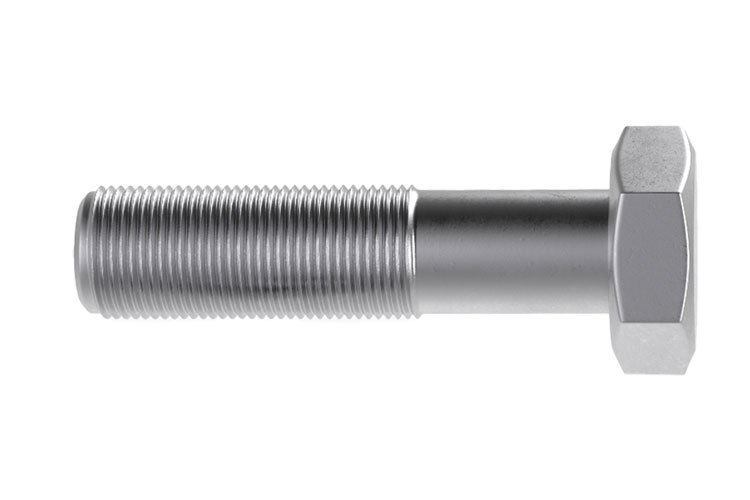
Fine-pitch threads are also known as Unified National Fine threads (UNF threads).
Fine threads are designed to meet the requirements where coarse threads cannot be used. Fine threads have a smaller pitch, which makes them more self-locking and prevents loosening. They also have more threads, which reduces leakage and achieves a sealing effect. In precision applications, fine-pitch stainless steel screws offer easier and more accurate control and adjustment.
The disadvantage of fine threads is their lower tensile strength compared to coarse threads, and they are prone to damage, making repeated disassembly and reassembly inadvisable.
Matching fasteners such as nuts may have equivalent precision, but even slight dimensional deviations can easily cause simultaneous damage to both the screw and nut.
Fine threads must be labeled with pitch to show the difference with coarse threads.
Characteristics of Fine Threads
Fine thread has a small space size, self-locking good, mostly used for the force is not big, can be accurately adjusted, such as a variety of optical instruments, lens fixation, micrometer and other instruments used for measuring purposes, some of the connectors with threads and do not want to use the tools, such as the oil cup cover, the metal casing light-emitting diode flashlight battery cover, and so on.
Due to the fine thread pitch is small, the height of the tooth type is small, the installation is easy to mess up the teeth appear in the case of not coming out, burrs on the assembly has a great impact, must be cleaned up. At the same time, the number of disassembly and installation of fine threads should not be too many.
Thread Standard Pitch Chart
| Nominal Diameter | Pitch (mm) | Nominal Diameter | Diameter Size | Pitch = Teeth Per Inch | |||
| mm | Coarse Thread | Fine Thread | < 1/4 inch | in | mm | Coarse UNC | Fine UNF |
| M1 | 0.25 | 0.2 | 0# | 0.06 | 1.524 | – | 80 |
| M1.2 | 0.25 | 0.2 | 1# | 0.073 | 1.854 | 64 | 72 |
| M1.6 | 0.35 | 0.2 | 2# | 0.086 | 2.184 | 56 | 64 |
| M2 | 0.4 | 0.25 | 3# | 0.099 | 2.515 | 48 | 56 |
| M2.5 | 0.45 | 0.35 | 4# | 0.112 | 2.845 | 40 | 48 |
| M3 | 0.5 | 0.35 | 4# | 0.125 | 3.175 | 40 | 44 |
| M4 | 0.7 | 0.5 | 6# | 0.138 | 3.505 | 32 | 40 |
| M5 | 0.8 | 0.5 | 8# | 0.164 | 4.166 | 32 | 36 |
| M6 | 1 | 0.75 | 10# | 0.19 | 4.826 | 24 | 32 |
| M8 | 1.25 | 1 | 12# | 0.216 | 5.486 | 24 | 28 |
| M10 | 1.5 | 1.25 | 1 / 4“ | 0.25 | 6.350 | 20 | 28 |
| M12 | 1.75 | 1.25 | 5 / 16“ | 0.3125 | 7.938 | 18 | 24 |
Coarse Thread vs. Fine Thread
Basic Parameters
| Item | Coarse Thread | Fine Thread |
|---|---|---|
| Pitch | Large (e.g., M10×1.5, P=1.5mm) | Small (e.g., M10×1.25, P=1.25mm) |
| Thread Characteristics | Thick and deep | Fine and dense |
| Anti-loosening | Standard (requires use with lock washers) | Good |
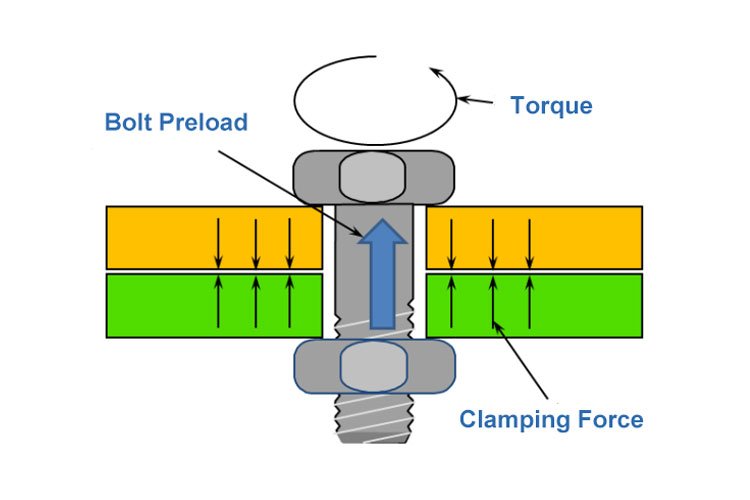
| Preload Force | Lower precision | Higher precision |
| Installation speed | Fast | Slow |
| Thread Damage Tolerance | High | Low |
| Cost and Versatility | Low, Universal | High, mostly non-standard |
Bearing Capacity
The load bearing capacity of coarse threads is usually greater than that of fine threads, but the specific differences need to be evaluated in the context of the application scenario and design parameters.
Tensile Strength
Coarse threads: large cross-section per thread and high utilization of material strength. Under the same nominal diameter, coarse threads have a higher tensile load carrying capacity (about 10-15% higher).
Formula: Tensile strength F = σ × A (σ is the yield strength of the material, A is the effective cross-section of the thread).
Example: M10 coarse thread (cross-sectional area ≈ 58mm²) tensile force ≈ 58 x 300MPa ≈ 17.4kN; fine thread (cross-sectional area ≈ 52mm²) ≈ 15.6kN.
Fine-pitch thread: Offers a large total contact area but low strength per thread, making it suitable for applications requiring load distribution (such as thin-plate connections).
Shear Strength
Coarse threads: thicker root for greater shear resistance. Under transverse loads, coarse threads have a lower risk of shear failure.
Formula: Shear force Fs = τ × As (τ is the shear strength of the material, As is the shear area).
Example: M10 coarse teeth shear area ≈ 45 mm², fine teeth ≈ 40 mm², coarse teeth shear approximately 12.5% higher.
Fine threads: more threads, more uniform load distribution, but the single thread shear area is small and needs to be compensated by increasing the number of threads.
Fatigue Life
Coarse thread: large root thickness, low stress concentration factor, longer fatigue life (approx. 20%-30% higher).
Case Study: In vibrating environments, the probability of loosening or breaking is lower for coarse-threaded bolts than for fine-threaded bolts.
Fine thread: more teeth, more uniform load distribution, but the root is thin, fatigue cracks expand faster.
Uses
Coarse Thread
Coarse threads are widely used in the mass production of bolts, screws, nuts and other threaded fasteners due to their high strength and good interchangeability. In the need for rapid assembly and disassembly occasions, coarse threads also show unique advantages. In addition, due to the easy disassembly and assembly of coarse threads and the complete set of standardized parts, they are also widely used in the fields of machinery manufacturing and automobile maintenance.
However, it should be noted that coarse threads have relatively poor self-locking properties and additional anti-loosening measures must be taken when used in vibrating environments.
Fine Thread
Due to the small pitch and good self-locking performance, fine threads are widely used in applications that require high self-locking performance. For example, in metric fittings, mechanical transmission components, and thin-walled parts with insufficient strength in hydraulic systems, the application of fine threads can effectively prevent fluid leakage and loosening. In addition, fine threads play an important role in internal parts and fine-tuning mechanisms where space is limited.
However, it should be noted that fine threads require high manufacturing accuracy and are relatively costly, so cost effectiveness needs to be considered when choosing to use them.
Application Recommendations
| Application Scenarios | Thread Type | Characteristics |
|---|---|---|
| High static loads (e.g. construction) | Coarse thread | High tensile and shear strength and low cost. |
| Vibration environments (e.g. machinery) | Coarse thread | Long fatigue life and excellent anti-loosening performance (with lock washers). |
| Thin plate connections (e.g. electronic) | Fine thread | Large total contact area and low load per unit area to avoid deformation of the sheet. |
| Precision adjustment (e.g. instruments) | Fine thread | Small pitch, high adjustment precision (e.g. M4×0.5 can realize 0.5mm/turn micro-adjustment). |
Summary
There is no such thing as “who is better”, only whether it is suitable or not. A truly professional fastener selection must take into account the working environment, material matching, assembly method, maintenance cycle, cost and supply chain stability.
If you have any questions about threaded fasteners, please feel free to contact us online. As a professional fastener supplier in China, we are able to provide you with a full line of products in both metric and inch systems.
Our Services
BD Fastener offers customized solutions for coarse and fine threaded fasteners:
- Process: using CNC lathe with thread rolling machine, thread precision (6g/6H grade).
- Material: carbon steel, stainless steel and other materials are available.
- Surface treatment: zinc plating, Dacromet, phosphating and other processes are available.
- Customized service: support the design and production of non-standard threads (such as special pitch and tooth type).