In the field of machinery assembly, equipment manufacturing, bolt connection due to high reliability, easy disassembly and installation, has become one of the widely used connection methods.
Many technicians often confuse “preload” and “clamping force” two key concepts, if the difference between the two do not understand clearly, may lead to loosening of the bolt connection, equipment failure and other problems, affecting production safety and product quality.
This blog will start from the essence of the concept, interrelationship and design points, a detailed analysis of the difference between preload and clamping force, and explain their importance in practical applications, while through the M8 × 25 10.9 grade bolts of the example of the specific analysis, to help the relevant personnel accurately control the quality of the bolt connection.
What Is Bolt Preload?
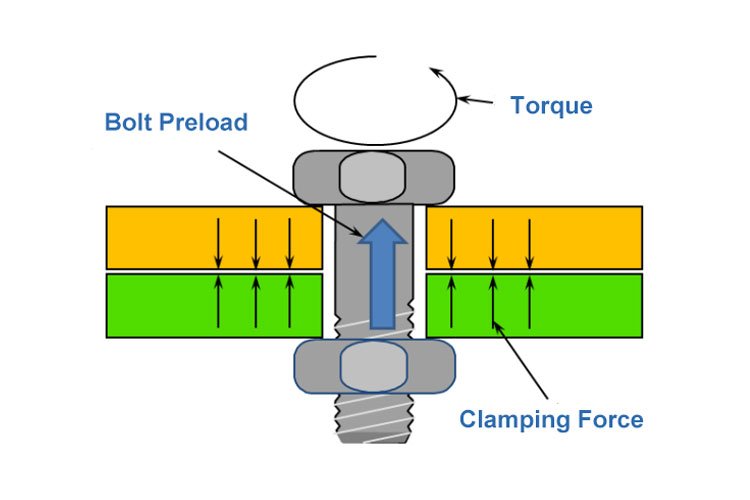
Preload is generated in the bolt tightening process, when using tightening tools (such as sensor-type tightening gun) to apply force to the bolt, the bolt will be stretched due to the force, and then form an axial tension force within itself, which is the preload force. Simply put, preload is the internal tensile force acting on the bolt, which is related to factors such as tightening torque, bolt material and friction. Calculation of the preload force usually takes into account the yield strength of the bolt material, the safety factor and its nominal cross-sectional area.
What Is Bolt Clamping Force?
The clamping force acts between the connecting parts and is an indirect force generated after the bolt is preloaded. When the bolt is stretched due to the preload, it exerts a “compression” effect on the connected components, causing multiple connecting parts to fit tightly together. This compressive pressure between the contact surfaces of the connecting parts is the clamping force.
Its primary function is to prevent relative sliding or separation of the connected components and to ensure sufficient contact area between parts for load transfer. It is the key to guaranteeing the “tightness” of the bolted connection. The magnitude of the clamping force is influenced by both the preload and the structural design of the connection.
Dynamic Relationship Between Preload and Clamping Force
Without external load: equal values.

In the static state where the equipment is not in operation and the bolted connection is not subjected to additional external forces (e.g. vibration, impact, working pressure, etc.), the preload force of the bolt is equal to the value of the clamping force between the connecting parts. At this time, the tensile tension of the bolt is completely transformed into the extrusion pressure of the connecting parts, and the two form a balanced state, which jointly maintains the stability of the bolt connection and ensures that the connecting parts will not loosen.
With external load: preload force is stabilized, clamping force may be reduced.

The situation changes when bolted connections are subjected to external loads. Even if the preload force of the bolts themselves does not change, the clamping force between the connected parts may be reduced as a result. This is because the external load creates a “tendency to separate” the connection, which corresponds to a certain degree to cancel out the squeezing effect of the preload on the connection, resulting in a weakening of the clamping force. If the external load continues to become larger, even exceeding the preload force of the bolt, the clamping force may drop to zero, at which time the squeezing pressure between the connecting parts is lost, and the stability of the bolted connection will be undermined, making it easy for the connecting parts to slide and the bolts to loosen, which may lead to equipment failure in serious cases.
How to Ensure a Reliable Connection?
Based on the relationship between preload and clamping force, the bolt joint design stage should place particular emphasis on the effects of external loads to ensure that the joint remains reliable under all operating conditions:
Prioritize the analysis of external loads.
When designing, the type and strength of external loads that the bolted connection may be subjected to need to be evaluated in relation to the operating scenario of the equipment. For example, vibration loads need to be considered for equipment with frequent vibration, and pressure loads need to be considered for equipment in high-pressure environments. And based on the external load, determine the required preload size of the bolt, to ensure that even in poor working conditions, the clamping force will not be reduced to zero, but still maintain a close fit of the connecting parts.
Matching bolts to preload requirements
Select bolts of appropriate specifications and strength grades based on the preload magnitude determined by the design. Different bolt types exhibit varying capacities to withstand tensile forces. If bolt strength is insufficient, it may fail to consistently provide the required preload, leading to preload decay and consequently affecting clamping force. Conversely, excessively high bolt strength may result in material waste or even damage to connected components due to excessive rigidity.
How to control bolt preload?
During the bolt tightening process, it is recommended to use professional tools with torque control functionality (such as sensor-equipped torque guns). These tools can regulate the bolt’s preload by controlling the tightening torque, preventing excessive or insufficient preload caused by inconsistent manual tightening force. Only when the preload meets the design requirements can the clamping force remain stable, thereby ensuring the reliability of the bolted connection from an operational standpoint.
Case Analysis
Bolt diameter D=8mm, length L=25mm; material 10.9 grade steel, yield strength=1090MPa. which:
A is the bolt cross-sectional area π × D2 /4 = 50.27mm2 ; safety factor n take 0.8;
Then Fp = 50.27×1090/0.8 = 68600N;
At this time, the clamping force Fc = Fp = 68600N.
Total load Ftotal = external load F + preload force;
Fp = 20000+68600=88600N。
Assuming a modulus of elasticity E = 210GPa, the deformation δ = Ftotal/AE = 0.1mm is obtained by simplifying the spring equation;
As the deformation introduces 0.1mm of slack, the clamping force is reduced to Fc = 68600-20000 = 48600 N. The preload force remains unchanged, Fp = 68600 N; however, the clamping force is reduced, Fc = 68600-30000 = 38600 N. The connection may fail, and the preload and clamping forces are difficult to determine.
Summarize
- No external load: The preload force of the bolt is completely transformed into the clamping force, in which case the two values are equal.
- External load in the elastic range: deformation of the bolt absorbs part of the load, the clamping force may be reduced, but the total load may exceed the sum of the preload and external load.
- External load below the preload: no significant deformation of the bolt occurs, the preload remains unchanged, but the clamping force is reduced.
- The external load exceeds the preload force: the bolt stretches further, which may lead to separation of the connection and loss of clamping force, threatening the stability of the connection.
- The external load is much greater than the preload force: the clamping force may drop to zero, the connection loses contact, resulting in separation, and the external load becomes the main force maintaining the connection.
When designing and calculating bolted connections, a variety of factors need to be taken into account, such as material properties and environmental factors, to ensure the reliability of the connection:
- Preload torque: Select the appropriate preload torque to ensure that the desired preload force is achieved.
- Coefficient of Friction: Consider the coefficient of friction between the connecting surfaces, as it will affect the amount of clamping force.
- Material Properties: The material properties of the connected parts can also affect the clamping force, such as modulus of elasticity and yield strength.
- Environmental factors: Ambient temperature, humidity, etc. also affect the preload and clamping force of the bolt.
By analyzing the example of a grade 10.9 bolt of M8 x 25, we can see that there may be a numerical difference between the preload force and the clamping force. The preload force is the maximum force that the bolt material can withstand, while the clamping force is the force that actually acts on the connected parts. When designing and using bolted connections, it is important to fully consider the difference and connection between these two forces and their impact on the stability and safety of the structure as a whole.
Conclusion
Preload and clamping force are two easily confused yet critical concepts in bolted connections. The former refers to the axial tensile force within the bolt itself, while the latter denotes the compressive pressure between connected components. The relationship between these two forces dynamically changes with external loads. In practical design and application, it is essential to clearly distinguish between these two forces, focus on the impact of external loads, determine the preload appropriately, select suitable bolts, and utilize professional tools to control the tightening process. Only then can the stability and reliability of bolted connections be ensured, safeguarding the safe operation of equipment.