History
Imperial (Inch) screws originated in the United Kingdom and have a long history. During the Industrial Revolution, Britain leveraged its strong industrial capacity to spread imperial standards worldwide—especially across Commonwealth countries and regions influenced by British engineering practices. These standards were largely developed based on tradition and practical experience, evolving over time into a distinct system.
Metric screws emerged alongside the global push for international standardization. To enable interchangeability and compatibility of industrial products worldwide, countries gradually unified around the metric system. With broad international participation in its development and refinement, the metric standard has become the dominant system in modern industry.

Units and Standards
Imperial (inch) screws follow the British measurement system, with dimensions specified in inches (1 inch = 25.4 mm). Metric screws use the internationally adopted metric system, with dimensions expressed in millimeters, offering clearer notation and easier calculation.
For example, an imperial screw marked 1/4″–20 indicates a nominal diameter of 1/4 inch (major diameter 6.35 mm) with 20 threads per inch (TPI). In contrast, a metric screw marked M24 × 3 indicates a nominal diameter of 24 mm and a 3 mm thread pitch.
Metric screw standards are defined by ISO 68-1 and ISO 261 and are widely adopted in over 140 countries, making them the dominant standard in global manufacturing and trade.
Thread Standards and Thread Angle
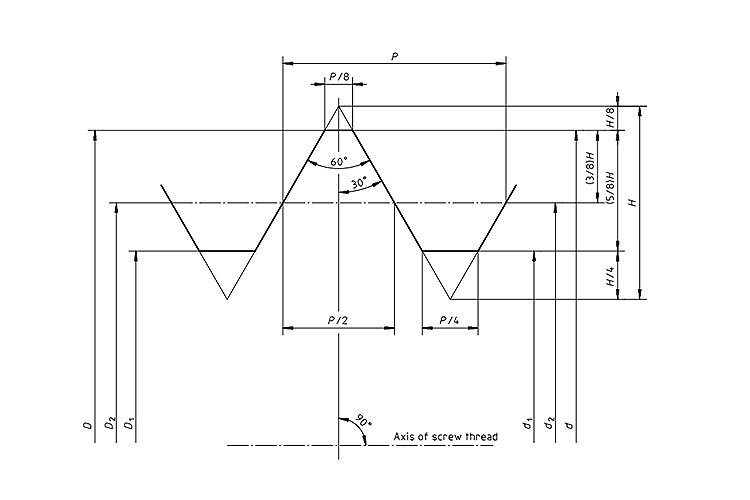
Imperial threads are classified into 55° and 60° thread angles.
- 55° threads belong to the Whitworth thread system, which has been traditionally used in Europe and Commonwealth countries, especially in piping and plumbing applications.
- 60° threads correspond to the Unified Thread Standard, which is widely used in North America.
Whitworth Threads (55° thread angle)
- British Standard BS 84
- Common types: BSW (British Standard Whitworth, coarse thread), BSF (British Standard Fine)
Unified Threads (60° thread angle)
- American Standard ANSI B1.1
- Common types: UNC (Unified National Coarse), UNF (Unified National Fine)
Metric threads, by contrast, are largely standardized and primarily adopt a 60° symmetric thread profile. In addition to standard metric threads, the metric system also includes several functional thread forms used for power transmission and special applications, such as:
- Metric standard threads: 60° thread angle
- Trapezoidal threads: 30° thread angle
- Buttress threads: 33° thread angle
- Square threads: rectangular profile for high efficiency
Thread Designation Method
Imperial threads are designated by “nominal size × threads per inch (TPI)”.For example, 3/4″-10 indicates a nominal diameter of 3/4 inch with 10 threads per inch.
Metric threads are designated by “M + nominal diameter × pitch”.
- For coarse threads, the pitch is usually omitted. For example, M24 implies a standard coarse pitch of 3.0 mm.
- For fine threads, the pitch must be explicitly stated. For example, M24×1.5 indicates a pitch of 1.5 mm.
- Left-hand threads must be identified by adding “LH” (Left Hand) after the designation.
Pitch and Machining
Metric Screws
- Ductile materials: Tap drill diameter = Thread major diameter – Pitch
- Brittle materials: Tap drill diameter = Thread major diameter – 1.1 × Pitch
- The thread pitch is expressed in millimeters. Coarse threads (e.g., M8 with a 1.25 mm pitch) offer higher machining efficiency, while fine threads (e.g., M8×1.0) provide greater precision.
Imperial Screws
- The pitch is expressed as threads per inch (TPI). For example, 1/4″-20 means 20 threads per inch.。
- The tap drill diameter must be determined by standard reference tables; the calculation is more complex and largely dependent on empirical data and standards.
Application Scenarios
Imperial screws, due to historical reasons, still dominate mechanical manufacturing, aerospace, shipbuilding, and related industries in English-speaking countries and former British colonies. Metric screws, as an internationally standardized system, are the mainstream choice in Europe, Asia, and Africa. With the acceleration of globalization, metric screws are becoming increasingly important in the global market thanks to their strong interchangeability and lower production costs.
Metric Screws
- High-load applications: Coarse threads are preferred, especially for sizes M10 and above, as they provide better load-bearing capacity and higher resistance to thread stripping.
- Thin-walled materials (wall thickness < 2 mm): Fine threads are recommended to reduce the risk of thread stripping and improve engagement strength.
- Typical advantages and applications: Widely used across global manufacturing—including automotive, machinery, and construction—metric screws excel in high-load joints and thin-walled component fastening (with fine threads).
Imperial Screws
- Whitworth threads: Suitable for traditional applications requiring inherent self-locking characteristics, such as older British machine tools.
- Unified threads (UNC/UNF): Used in modern North American products aligned with international standards, such as U.S. aerospace components.
- Key Applications: Maintenance of equipment in traditional imperial-system countries (e.g., UK piping systems), products for the North American market (e.g., automotive components).
Overview of Differences
Metric Screws
- Strong global compatibility. ISO standards ensure interoperability across countries, reducing production and assembly errors.
- Inspection tools (such as go/no-go gauges and plug gauges) are standardized based on a 60° thread angle, offering higher convenience and consistency.
Imperial Screws
- Due to differences in thread angle and measurement units between Whitworth and Unified threads, interchangeability is limited and often requires conversion tools or custom adapters.
- Outside the North American market, globalization costs are higher, as additional adaptation and compatibility measures are usually required.
| Characteristics | Metric Screws | Imperial Screws |
| Unit | Millimeter (mm) | Inch |
| Thread Angle | 60 degrees (standard specification) | 55° (Whitworth thread) or 60° (Unified thread) |
| Pitch Indicates | Pitch (millimeters) | Teeth per inch (TPI) |
| Designation Examples | M8 (coarse thread), M8×1.25 (fine thread) | 1/4″-20 (1/4-inch diameter, 20 threads per inch) |
| Application Scenarios | Global Manufacturing (Automotive, Machinery, Construction, etc.) | Traditional imperial countries (United Kingdom, India) and North America |
Standard System
| Comparison Item | Metric thread | British Standard Thread |
| Standard System | ISO/GB | BSW/BSF |
| Thread Profile Characteristics | Equilateral triangle | Isosceles triangle |
| Application Region | China, Europe, etc. | The United Kingdom and Commonwealth countries |
| Strength Characteristics | High tensile strength | Excellent sealing performance |
| Interchangeability | Globally standardized | Region-specific standards |
Frequently Asked Questions
Should metric or imperial screws be used in a project?
As a general rule, metric screws should be prioritized due to the global compatibility of ISO standards.
If imperial screws must be used, clearly specify the thread standard (such as UNC or UNF) and provide appropriate conversion adapters to ensure compatibility.
How can strength and sealing be achieved in precision instruments?
Metric fine threads (e.g., M3×0.35) combined with O-rings achieve a balance between mechanical strength and sealing performance.
Imperial unified threads (e.g., 4-40 UNF) improve self-locking capability through a finer pitch, making them suitable for optical equipment adjustment.
What should you do if screws on old equipment (such as British-made machine tools) are damaged?
Prioritize sourcing original manufacturer parts, or use thread conversion tables to match approximate metric screws. For example, BSW 1/4″-20 can be temporarily replaced with M6×1.0 metric fine-pitch thread (requiring adjustment of the pilot hole diameter).
How to quickly distinguish between metric and imperial screws?
- Observation Notes: Metric screws are labeled as “M8×1.25,” while imperial screws are labeled as “1/4-20.”
- Measure diameter: Use calipers to measure screw diameter. Metric screws have integer or decimal values (e.g., 8mm), while imperial screws use fractions (e.g., 1/4 inch ≈ 6.35mm).
- Test fitting tool: Attempt to screw in with a metric wrench. If it cannot be fully inserted, it is an imperial screw.
Can metric screws be used interchangeably with imperial screws?
Metric and imperial screws cannot be directly interchanged due to differing dimensional units. For example, an M8 screw cannot be screwed into a 1/4-inch threaded hole; forced installation may cause stripping or equipment damage.
Metric and Imperial Screw Manufacturers
BD Fastener has introduced internationally advanced manufacturing and testing equipment and established its own R&D center. We specialize in producing high-quality fasteners that comply with GB, DIN, ASTM, ISO, JIS, and other international standards, as well as a wide range of custom non-standard parts. Guided by the principle of “integrity first, transparency, and mutual benefit,” we are committed to becoming a trusted long-term partner for our customers.
Manufacturing capacity
- Equipped with precision thread processing equipment imported from Germany and Japan
- Fitted with a full suite of inspection instruments including coordinate measuring machines and optical projectors
- Certified under international standards such as ISO 9001 and IATF 16949
Main Products
- Bolts: U-bolts, wing bolts, square-head bolts, hex socket bolts, hex head bolts, etc.
- Studs: Partially threaded studs, fully threaded studs, etc.
- Nuts: Wing nuts, lock nuts, hex nuts, flange nuts, etc.
- Screws: Self-tapping screws, wood screws, drywall screws, self-drilling screws, etc.
- Washers: Flat washers, spring washers, lock washers, etc.
- Non-standard fasteners: Customized according to customer requirements.