Bolts are common fasteners used in mechanical manufacturing, automotive engines, energy equipment, bridge structures, petrochemical installations, and aerospace applications. In actual operating conditions, whether exposed to high or low temperatures, or subjected to frequent thermal cycling, these factors directly impact the strength, clamping force, and service life of bolts. This article will cover the operating temperature range of bolts, potential issues arising from thermal exposure, and methods to enhance bolt performance.
Carbon Steel Bolts
Carbon steel bolts are the most commonly used threaded fasteners. Their typical operating temperature range is –40°C to 425°C. At elevated temperatures, carbon steel bolts are prone to embrittlement, which can lead to a reduction in strength. To improve their performance under high-temperature conditions, appropriate heat treatment processes—such as tempering—can be applied to enhance their mechanical properties and stability at elevated temperatures.
Stainless Steel Bolts

Stainless steel grades 304 and 316 maintain tensile strength at temperatures below 100°C. However, beyond 100°C, yield strength decreases by 5% for every 100°C increase in temperature. Use is not recommended at temperatures exceeding 400°C.
Stainless steel 304 products have a minimum applicable temperature range up to -200°C. 316 bolts, screws, and similar products are only suitable for temperatures up to -60°C, while studs are applicable up to -200°C. Increased product deformation and reduced temperatures affect the Mo element within the material, compromising stability and increasing fracture risk.
Duplex stainless steel 2205 can withstand high temperatures up to 600°C. Martensitic heat-resistant steel fasteners—such as those made from 410 or S47310 (including customized bolts, slotted nuts, etc.)—can operate at maximum service temperatures of up to 800°C.
Titanium Alloy Bolts
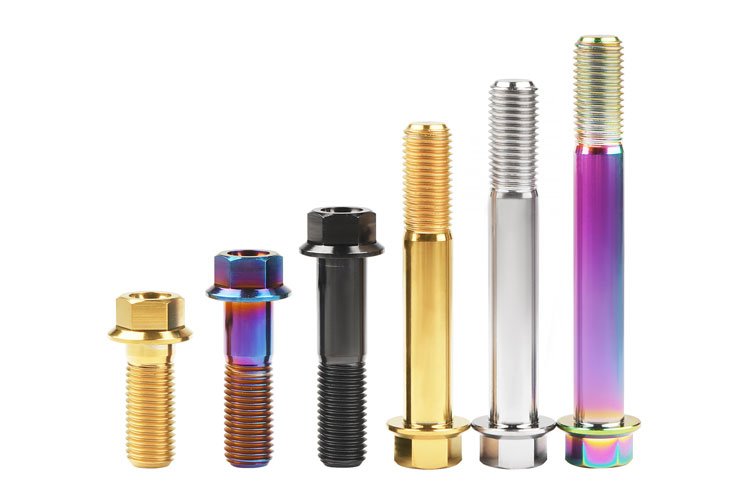
Titanium alloy bolts are commonly used in high-temperature and high-pressure environments. Their typical operating temperature range is –250°C to 550°C. Due to the relatively low thermal conductivity of titanium alloys, these bolts are more susceptible to deformation and stress concentration at elevated temperatures, which may ultimately lead to bolt fracture.
High-Temperature Alloy Bolts
High-temperature alloy bolts are fasteners specifically designed for use in extreme high-temperature environments. Their operating temperature range is typically 850°C to 1100°C. These bolts offer excellent strength and corrosion resistance and are able to maintain stable performance even under prolonged exposure to high temperatures.
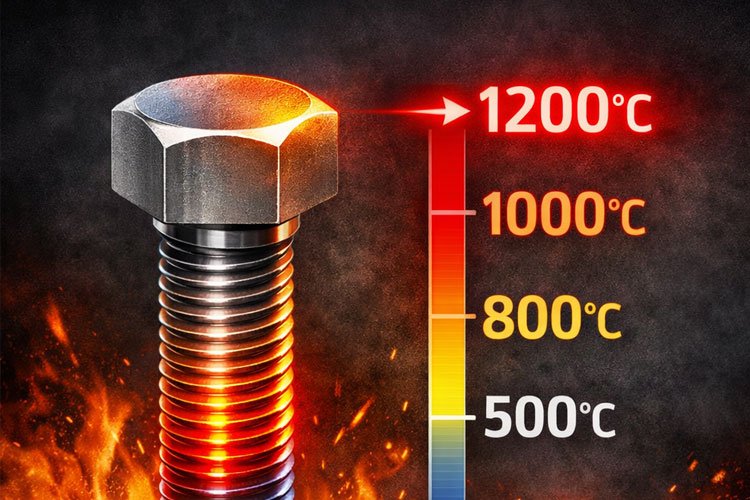
Bolt Temperature Range Chart
Bolt Temperature Range Chart
The operating temperature range of a bolt refers to the range within which the bolt can maintain its required performance characteristics without damage. Generally, the operating temperature range of a bolt is related to its material composition. Below are the operating temperature ranges for common bolt materials:
| Bolt Material | Plating material | Temperature Interval | Temperature Interval | ||
| Min T (oC) | Max T (oC) | Min T (oF) | Max T (oF) | ||
| Carbon steel/alloyed steel | Oiled | -50 | 120 | -58 | 248 |
| Carbon steel/alloyed steel | Zinc plating | -50 | 230 | -58 | 446 |
| Carbon steel/alloyed steel | Cadmium | -50 | 110 | -58 | 230 |
| Carbon steel/alloyed steel | Phosphate | -50 | 200 | -58 | 392 |
| Carbon steel/alloyed steel | Heavy zinc | -50 | 200 | -58 | 392 |
| Carbon steel/alloyed steel | Heavy phosphate | -50 | 200 | -58 | 392 |
| Carbon steel/alloyed steel | Nickel | -50 | 590 | -58 | 1,094 |
| Carbon steel/alloyed steel | Chromium | -50 | 650 | -58 | 1,202 |
| Stainless steel | – | -120 | 320 | -248 | 608 |
| Inconel | – | -250 | 650 | -418 | 1,202 |
| Waspalloy | – | -250 | 870 | -418 | 1,598 |
Potential Issues of Bolts at High or Low Temperatures
When a bolt operates beyond its designed temperature range, the following failures may occur:
- Strength Reduction and Creep
As temperature increases, the yield strength of the material decreases. Under long-term loading at high temperatures, creep may occur, leading to joint loosening.
- Thread Corrosion
In high-temperature environments, oxide layers are likely to form on the bolt surface, which can cause thread corrosion and adversely affect bolt strength and fastening performance.
- Bolt Deformation
High temperatures have a significant impact on bolts. Differences in thermal expansion and contraction can easily lead to bolt deformation, thereby impairing overall performance.
- Hydrogen Embrittlement and Coating Failure
When the temperature exceeds the tolerance limit of the coating, bolts may suffer from hydrogen embrittlement—brittle fracture caused by hydrogen absorption—which can result in bolt failure and serious consequences.
- Stress Relaxation and Loss of Clamping Force
In high-temperature environments, the preload of bolts gradually decreases, reducing clamping force and compromising structural safety.
- Low-Temperature Embrittlement
Carbon steel and alloy steel exhibit significant embrittlement below –50°C, increasing the risk of fracture under impact loading.
Methods for Enhancing Bolt Performance
To improve the high-temperature performance of bolts, the following measures can be adopted:
- Use High-Temperature-Resistant Materials
Select bolts made from heat-resistant materials such as nickel-based superalloys, stainless steel, titanium alloys, or ceramics. These materials offer excellent thermal stability and can meet the requirements of high-temperature operating environments.
- Optimize Bolt Manufacturing Processes
During bolt production, appropriate heat treatment processes—such as tempering and solution treatment—can be applied to enhance high-temperature stability, reduce surface brittleness, and improve resistance to cracking.
- Apply Surface Treatments
Special surface treatments, including nickel plating, chromium plating, and high-temperature coatings, can significantly improve a bolt’s heat resistance and corrosion resistance, thereby extending its service life.
- Strengthen Maintenance and Inspection
During service, bolts should be regularly inspected for clamping force and thread condition, including checks for deformation and corrosion. Any defective bolts should be replaced or treated in a timely manner to ensure reliability and prolong service life.
Conclusion
As commonly used fastening components, the operating temperature range of bolts has a significant impact on their performance stability and service life. In practical applications, appropriate strengthening measures should be selected based on the specific material of the bolt to enhance its high-temperature resistance. In summary, only by ensuring that bolts operate within a suitable temperature range can their safe, reliable, and long-term performance be guaranteed.