Chemical anchors, also known as chemical bolts, are a new type of fastener material. They consist of a screw, nut, washer, and chemical agent.

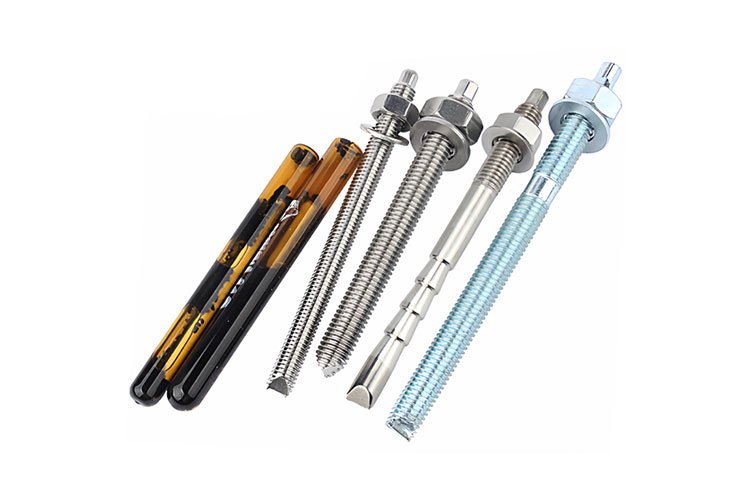
Chemical anchors, a new type of anchor bolt, emerged after expansion anchors. Using a specialized chemical adhesive, the screw is bonded to a drilled hole in the concrete base, creating a composite anchor for the fixture. Because chemical anchor bolts have a large pull-out bearing capacity, they can replace embedded anchor bars. They are often used to remedy the situation when steel structure embedded parts are forgotten to be installed at the construction site but the concrete has been poured.
Structure of Chemical Anchor
- Chemical agents (anchoring glue): It is usually a two-component (resin + curing agent), and common types include epoxy resin, vinyl ester, unsaturated polyester, etc.
- Screw: High-strength steel parts that have been galvanized or stainless steel are used to connect the fixed parts.
- Glass tube / hose: Chemicals are usually pre-installed in glass tubes or two-component rubber cartridges and injected into the hole together with the screw during installation.
Advantages
- Small bolt spacing and edge distances make it suitable for use in confined spaces.
- It is easy to install and can be quickly solidified after installation, and has a high bearing capacity.
- No expansion force anchoring, no squeezing force on the substrate, suitable for a variety of substrates.
- Excellent chemical composition and resistance to acids, alkalis, low temperatures, aging, and weathering.
- Good heat resistance and no creep at room temperature.
- Excellent weld resistance and flame retardancy.
- Excellent seismic performance, capable of withstanding long-term vibration loads.
Chemical Anchor Installation Steps
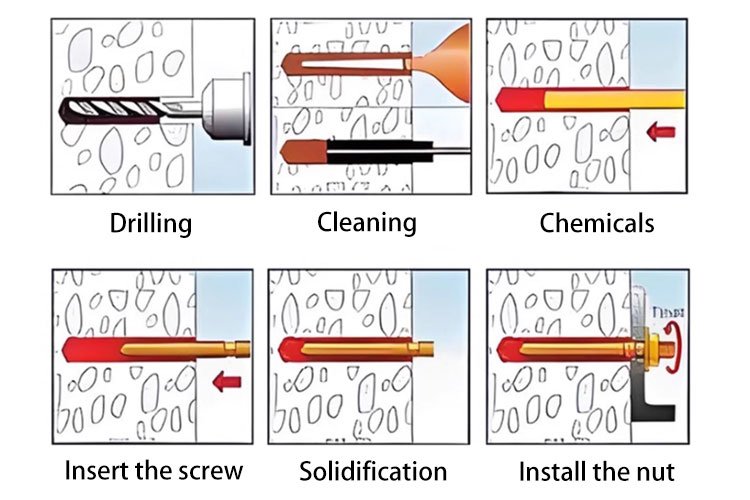
Step1: According to the engineering design requirements, holes should be drilled at corresponding positions in the base material (such as concrete). The hole diameter, hole depth and bolt diameter should be determined by professional technicians or on-site tests.
Step2: Use an impact drill or water drill to drill holes of specified diameter and depth in concrete or wall.
Step3: Use a special air cylinder, brush or compressed air machine to clean the dust in the drill hole. It is recommended to repeat it at least 3 times. There should be no dust and visible water in the hole.
Step4: Ensure the bolt surface is clean, dry, and free of oil and dirt.
Step5: Confirm that the glass tube anchor package is free of damage, solidified reagent, or other abnormalities. Insert the package into the anchor hole with the rounded end facing outward and push it all the way to the bottom.
Step6: Use an electric drill and a special installation fixture to forcefully rotate the screw until it reaches the bottom of the hole. Do not use impact.
Step7: When it reaches the bottom of the hole or the marked position on the bolt, stop rotating immediately, remove the mounting fixture, and avoid disturbance after gelation until it is completely cured. Overtime rotation will cause glue loss and affect the anchoring force. (The rotation time should not exceed 30 seconds, the rotation speed should not be lower than 300 rpm and not greater than 750 rpm, the bolt advancement speed is about 2 cm/s, and impact method is not allowed)
⚠️ Precautions for Use
- The hole wall must be clean and dry, otherwise it will affect the bonding strength.
- Do not apply force or vibration during curing.
- Epoxy adhesives will take longer to cure at low temperatures.
- Strictly adhere to the manufacturer’s design pull-out force and spacing requirements.
Common Chemical Anchor Types
| Types | Features | Typical Applications |
|---|---|---|
| Glass tube chemical anchor | The colloid is pre-sealed in the glass tube, which is easy to install | Early construction projects |
| Injection chemical anchor | Two-component glue cartridge is used with glue injection gun, and the glue amount is controllable | Modern Engineering |
| Epoxy resin type | High strength, high temperature resistance, acid and alkali resistance | Bridge and structure reinforcement |
| Vinyl ester type | Fast curing and corrosion resistance | Chemical plants, coastal projects |
Uses of Chemical Anchors
- Building structure reinforcement and renovation
- Steel structure and concrete connection
- Bridge, tunnel, and subway construction
- Equipment foundation installation
- Guardrail, railing, and curtain wall fixing
- Mechanical equipment and pipeline support installation
Difference from Expansion Bolts
| Item | Chemical anchors | Expansion bolts |
|---|---|---|
| Fixing method | Chemical bonding | Mechanical expansion |
| Substrate | Solid, slightly cracked concrete | Solid concrete |
| Carrying capacity | High | Medium |
| Margins | Small margins, can be close to the edge | Large margins, need to leave space |
| Vibration resistance | Excellent | good |
| Cost | Slightly higher cost | lower cost |
| Uses | Reinforced, heavy-duty structure | Ordinary assembly fixation |
Chemical anchors offer a high-strength, reliable structural anchoring solution, securing through chemical bonding rather than mechanical expansion. They are particularly suitable for high-load, RDF-resistant applications, renovations, and applications with limited margins.
With increasing requirements for building reinforcement and industrial equipment installation, chemical anchors are gradually replacing traditional expansion bolts and becoming a key anchoring technology of choice in modern engineering.


